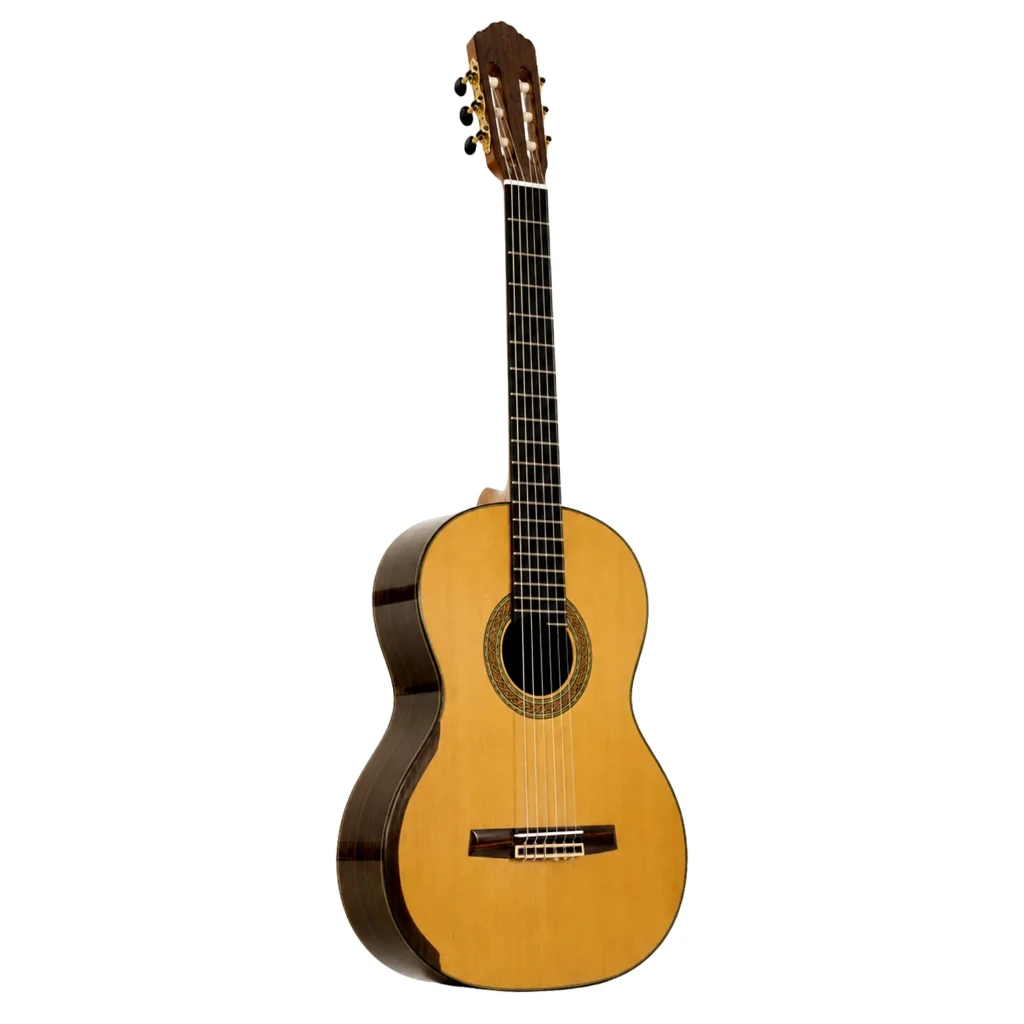
The Arrius MPR-5000 is the master-grade classical guitar of our MPR series and the instrument on which much of our reputation was built. Players often call it simply the Arrius 5000. It was designed for professional use and for the most demanding amateurs: a concert guitar that delights an audience and inspires the player, not only on stage but in the long hours of daily practice.
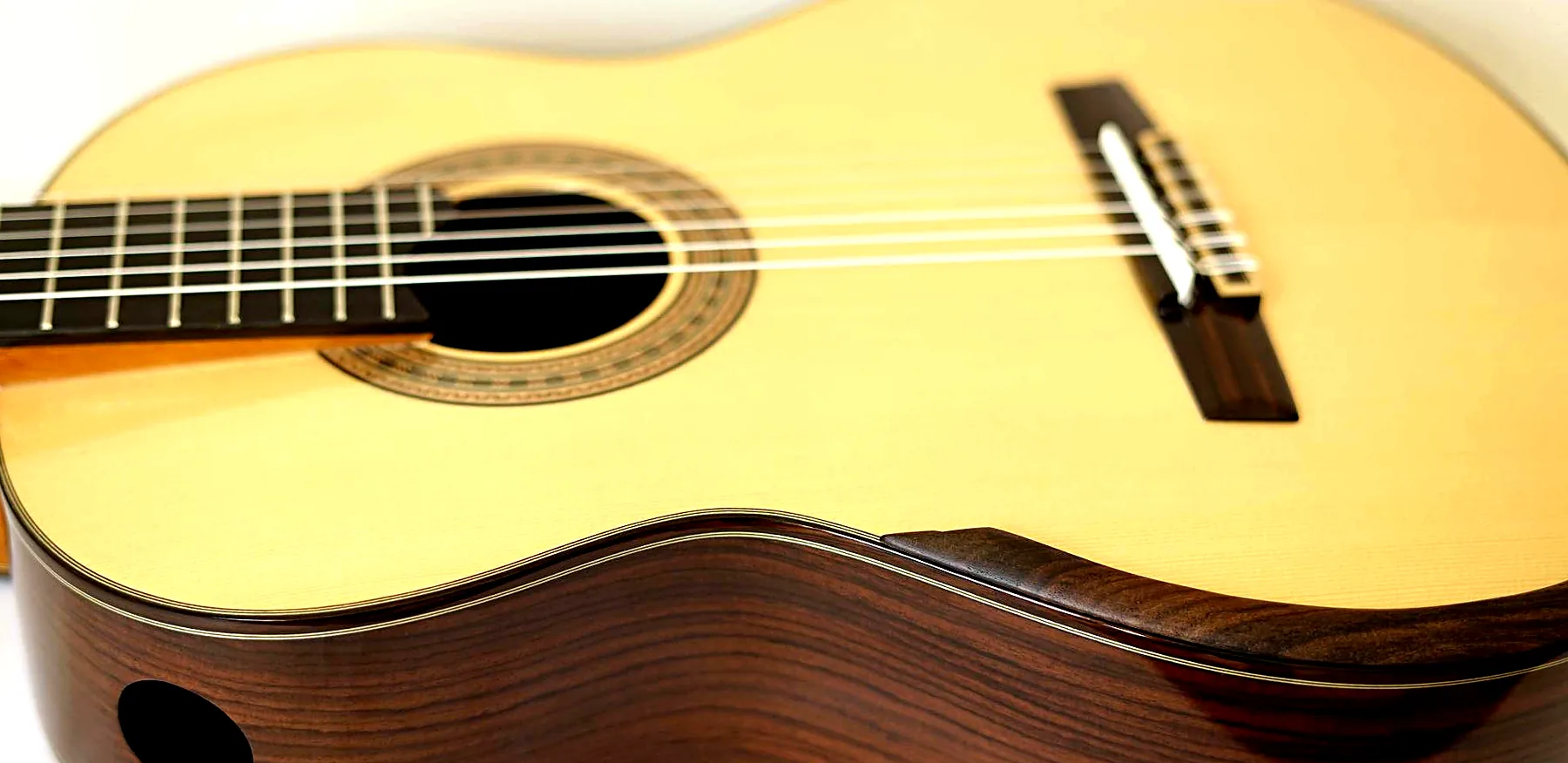
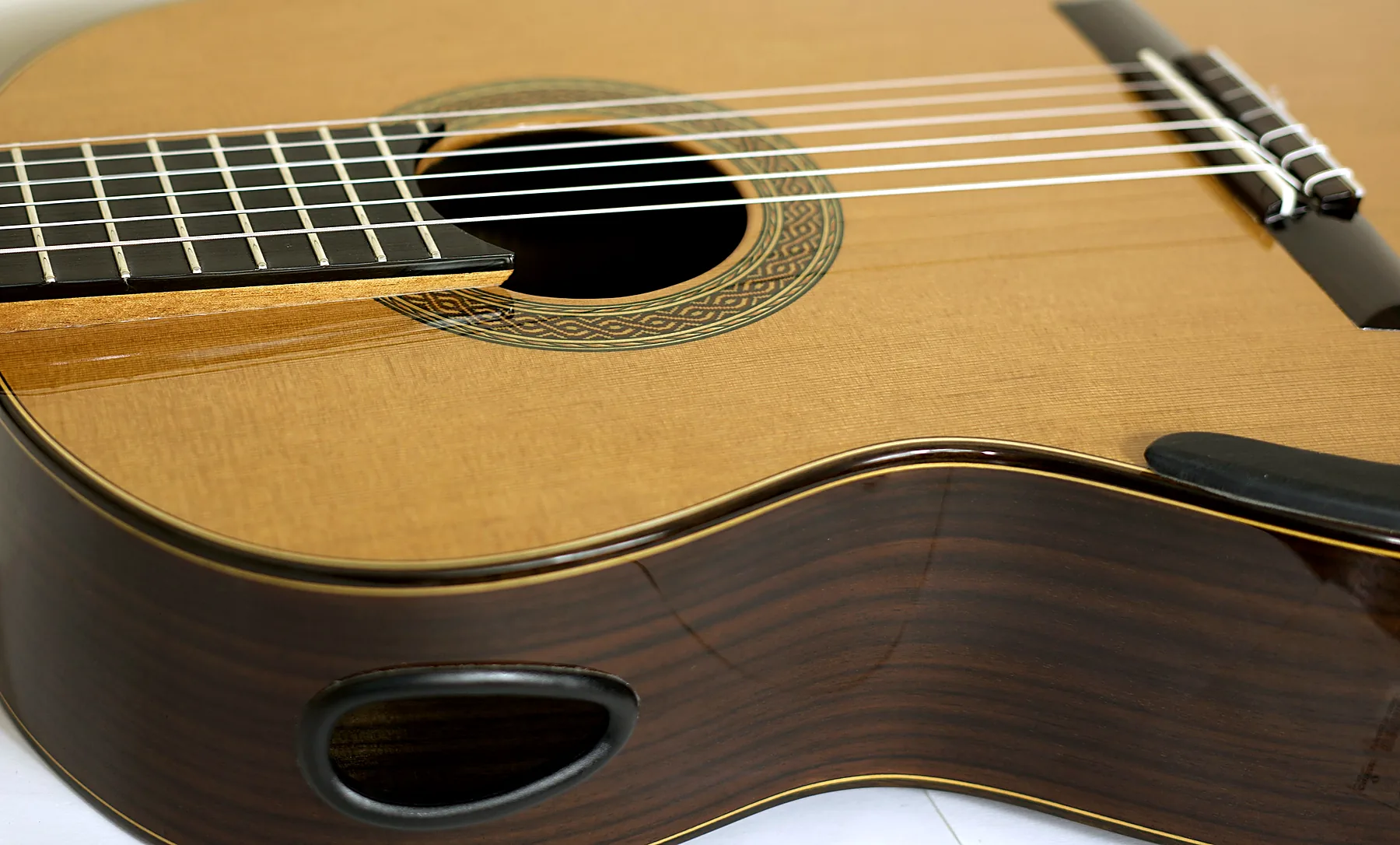
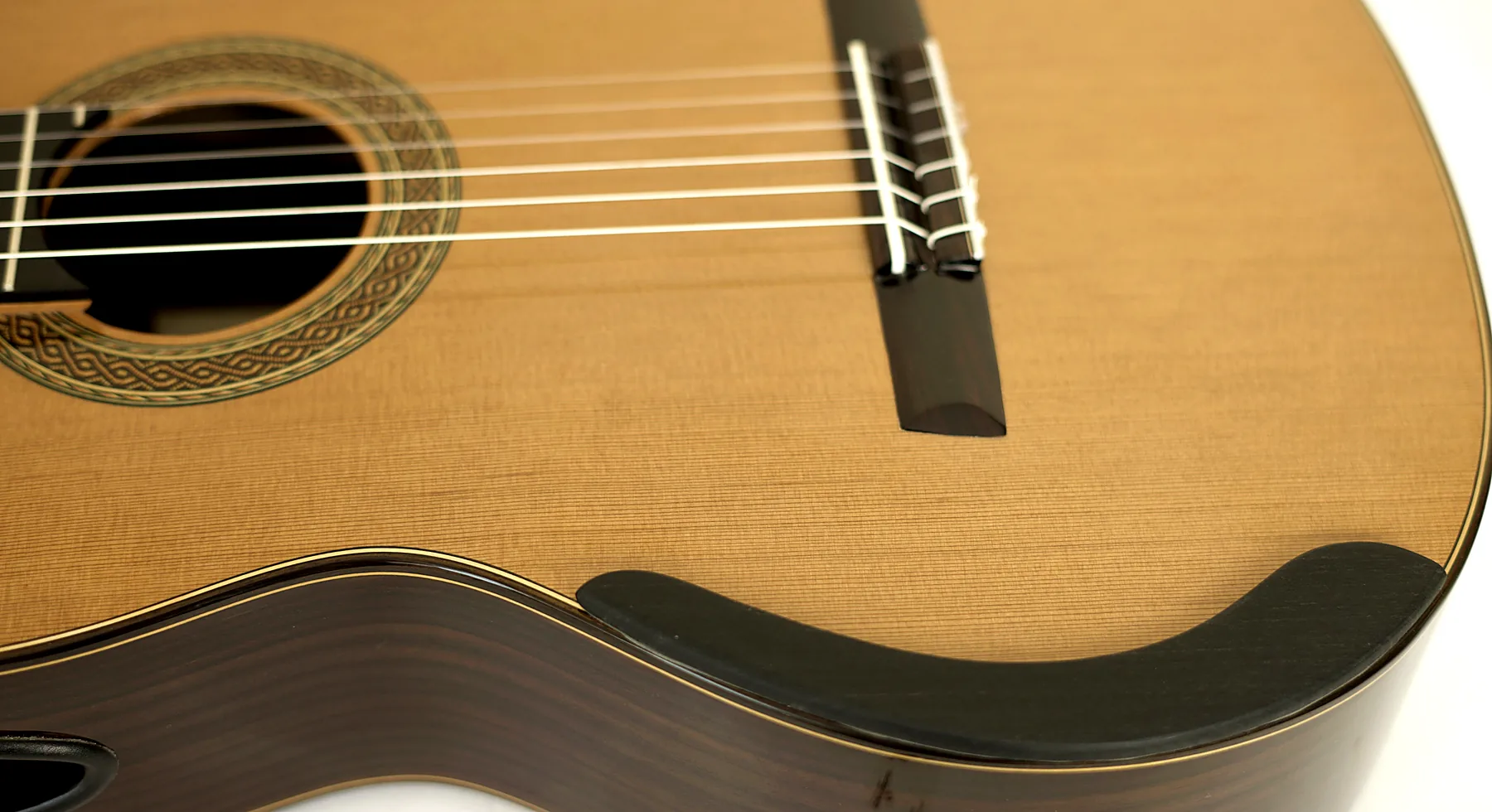
Four things make the MPR-5000 what it is: a special-grade solid Canadian cedar top over solid Indian rosewood, an additional resonance port that sends the sound towards the player, a raised fingerboard, and a solid ebony armrest. Below we describe each of them, and why it matters when you play.
The sound of the MPR-5000
The cedar MPR-5000 has a deep, warm and generous voice. It speaks at the lightest touch, its basses are full and round, and its trebles sing rather than snap. Thanks to the additional port you hear the guitar almost as the audience does, so you can shape a phrase with more precision and less effort. Inside, the body is fitted with numerous reinforcements and joints that colour and strengthen the sound; the construction allows up to 22% more volume while keeping the standard dimensions of a concert guitar.
The woods and what each one gives
For the MPR series we use some of the best tonewoods available, and the condition of our instruments long after their warranty period is the best evidence of it. Every piece comes from verified suppliers, holds the required certificates and is seasoned for at least eight years, which is why we can guarantee the structural stability of the guitar for its whole life.
Top: special-grade solid Canadian cedar
The soundboard decides more of a guitar’s voice than any other part. Cedar is lighter and less stiff than spruce, so it responds quickly and gives a warm, rounded tone that is full from the first day, without years of playing in. On the MPR-5000 we use special-grade wood with tight, even grain, which keeps that warmth clear rather than woolly. Read more about cedar and spruce tops.
Back and sides: solid Indian rosewood
Indian rosewood is the classic partner of a fine soundboard. It is dense and hard, so it reflects sound back into the body instead of absorbing it. That gives the MPR-5000 its deep basses, long sustain and the halo of overtones that surrounds each note. With cedar on top, rosewood adds weight and structure to an already warm voice. Compare rosewood, ziricote and Java ebony.
Neck: solid African mahogany
Mahogany is light and very stable. It keeps the neck straight under string tension for decades and keeps the balance of the guitar comfortable on the knee.
Fingerboard, bridge and armrest: solid ebony
Ebony is one of the hardest and densest woods used in guitar making. On the fingerboard it resists wear from strings and fingers and holds the frets firmly. On the bridge it carries the energy of the strings to the top without loss. On the armrest it gives a smooth, durable surface that stays beautiful for years.
Nut and saddle: bone
Bone is dense and hard, so it passes vibration from the strings to the neck and top more completely than plastic, and adds clarity and sustain.
The resonance port: you hear what you play
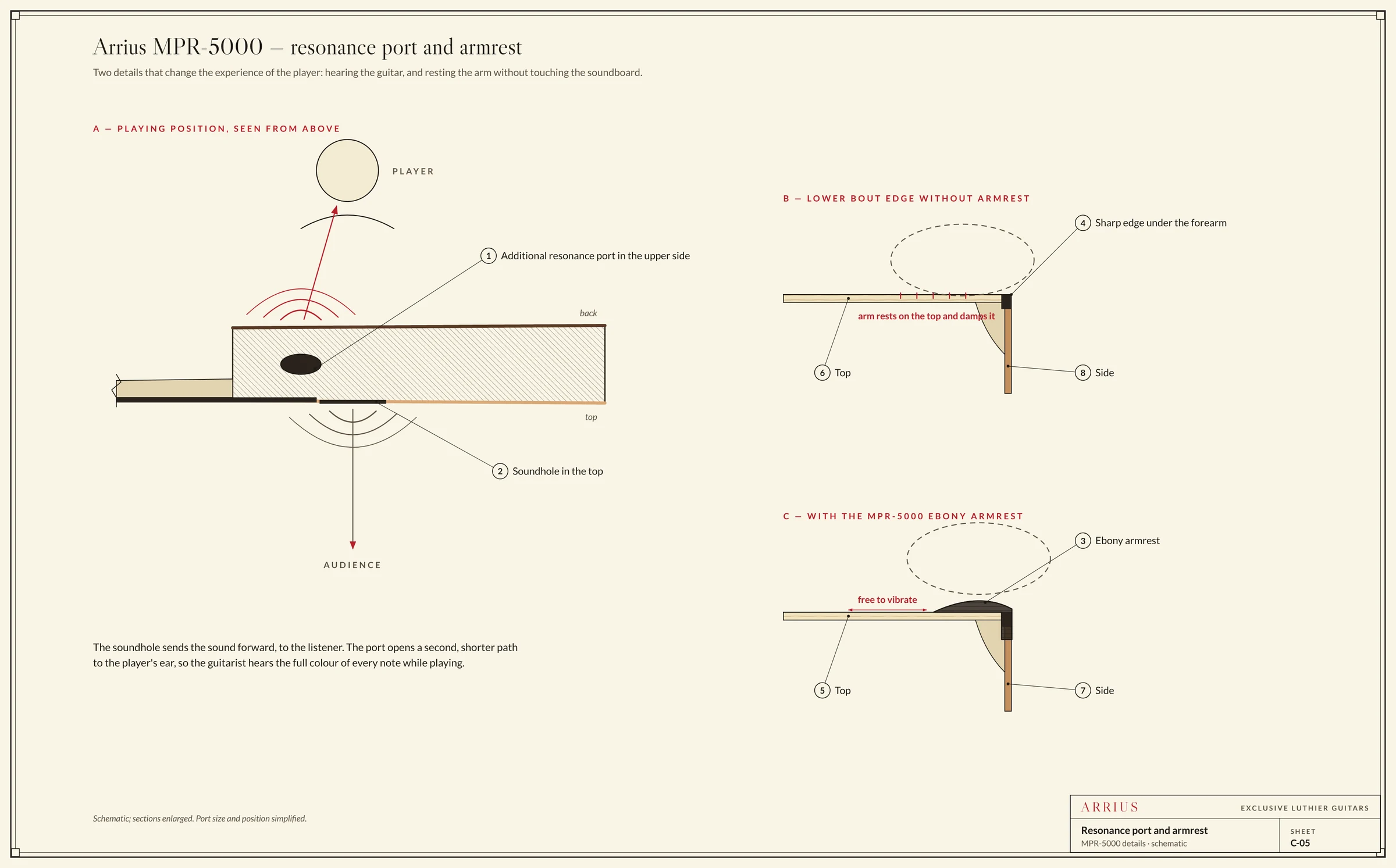
On a traditional guitar the sound leaves through the soundhole and goes forward, towards the listener. The player hears much less of it. The MPR-5000 has an additional resonance port in the upper side, part of our sound-projection system, which opens the voice of the guitar towards the player as well. You hear the full colour of every note, which changes the way you practise, shape dynamics and play with others.
The raised fingerboard: free access to the high positions
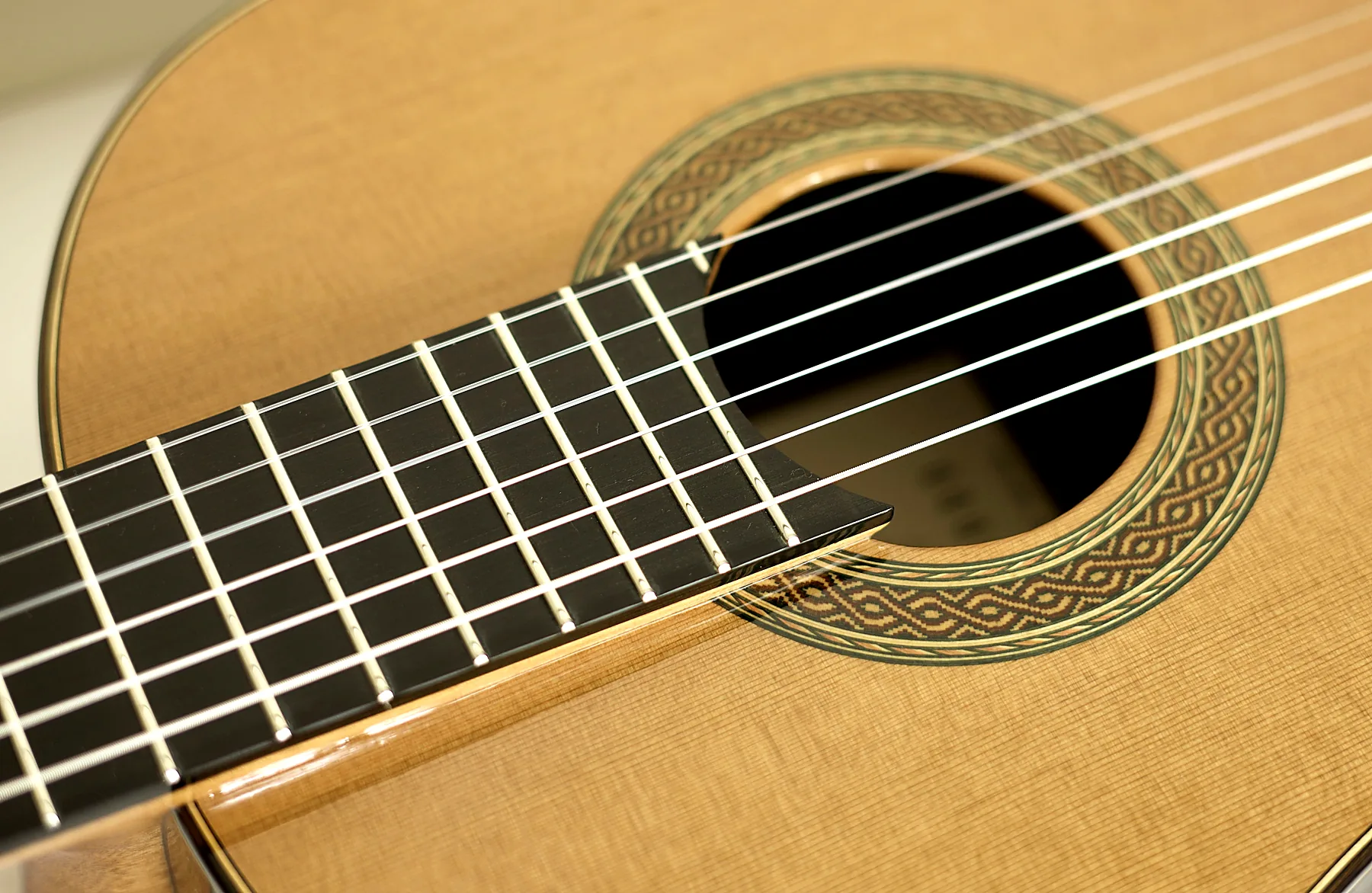
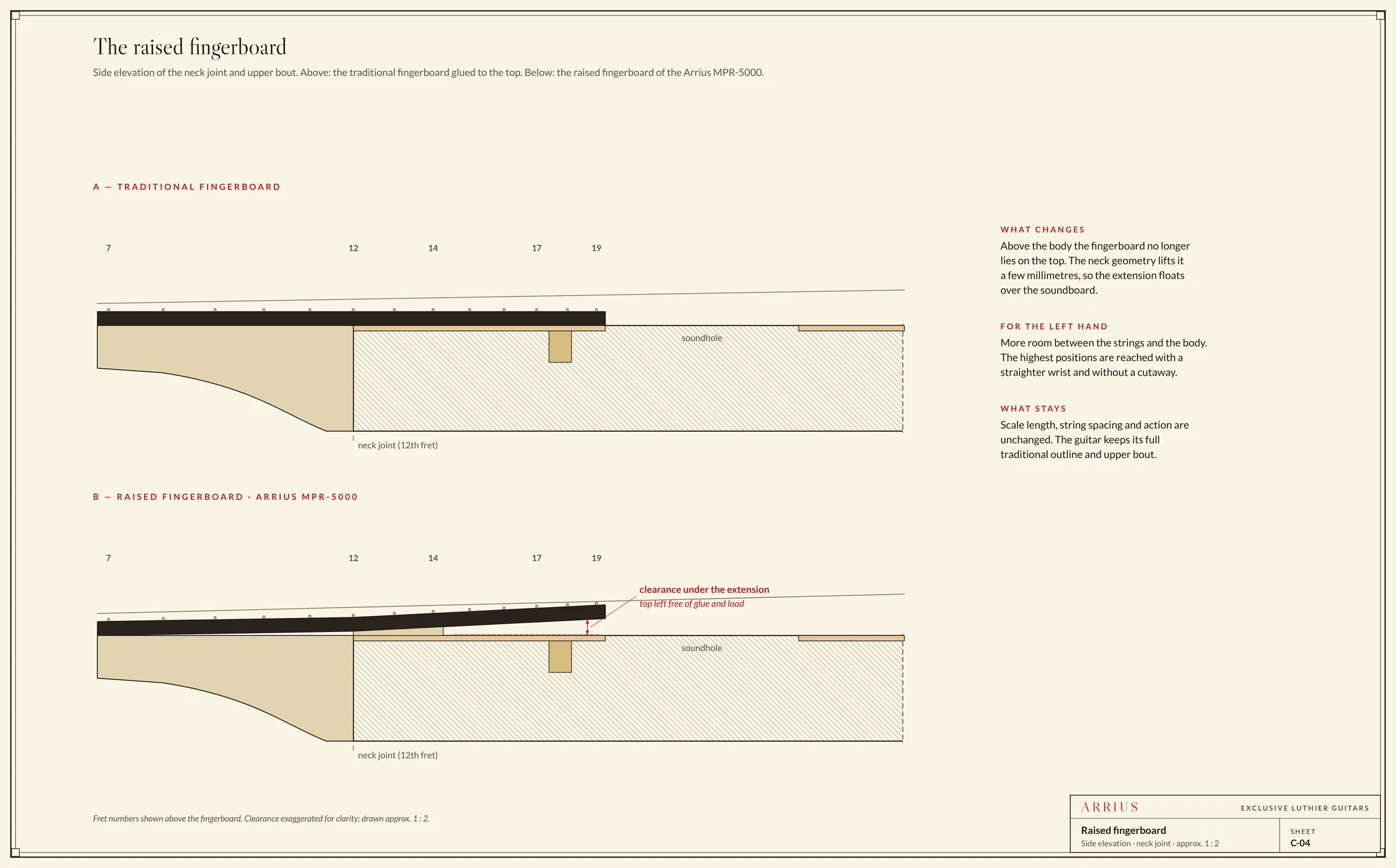
On the MPR-5000 the end of the fingerboard does not lie on the top; it is raised above it. The left hand reaches the highest positions comfortably, without the thumb and wrist fighting the edge of the body, and you keep the traditional shape of a concert guitar without a cutaway. The part of the top under the raised fingerboard is left free of glue and load, so it can vibrate. Many respected makers of concert guitars build raised fingerboards for the same reasons.
The ebony armrest: comfort, protection and a freer top
The armrest is a smooth ebony bevel on the edge of the lower bout, where your right forearm rests. It does three things:
- Comfort. There is no sharp edge pressing into the forearm, so long practice sessions and concerts are less tiring.
- A freer top. The forearm rests on the armrest rather than on the soundboard, so the top is not damped by its weight and can vibrate more freely.
- Protection. The armrest takes the wear that sweat and friction would otherwise leave on the top, the binding and the side.
Details that complete it
We kept the outward look of the MPR-5000 conservative and close to the earlier model; its secret is inside. The binding is built up of eight layers of African rosewood and maple. Gold machine heads and Hannabach hard-tension strings with gold-plated basses complete an instrument that looks as considered as it sounds. The MPR-5000 also exists in sub-models and finish variations; ask us about the current versions.
For lovers of precious details
For our most demanding customers we prepare limited series of the MPR-5000 with headstocks set with Swarovski crystals, moissanite or diamonds, and fitted with gold details. These commissions are priced individually, according to the specification and size of the decoration. Ask about a limited series.
Arrius MPR-5000 specification
| Top | Special-grade solid Canadian cedar |
| Back and sides | Solid Indian rosewood |
| Neck | Solid African mahogany |
| Fingerboard | Solid ebony, raised |
| Bridge | Solid ebony |
| Armrest | Solid ebony |
| Sound projection | Additional resonance port in the upper side |
| Nut and saddle | Bone |
| Machine heads | Gold, special |
| Strings | Hannabach, hard tension, gold |
| Binding | African rosewood and maple, 8 layers |
| Scale length | 650 mm |
| Nut width | 52 mm |
| Body width / upper bout | 370 mm / 280 mm |
| Body length / depth | 480 mm / 100 mm |
MPR-5000 compared with other Arrius models
MPR-5000 or MPR-400? The MPR-400 is the younger sibling of the MPR-5000. It keeps the solid woods and hand assembly at a lower price, but it has neither the additional resonance port nor the raised fingerboard.
MPR-5000 or S-1000? The S-1000 has a double top of cedar and spruce and is built for maximum power and projection in large halls. The MPR-5000 has a solid cedar top and a warmer, more intimate voice that rewards the player as much as the listener.
MPR-5000 or MPR-100 S? The MPR-100 S reaches the high positions through a rounded cutaway; the MPR-5000 does it with a raised fingerboard and keeps the full traditional body.
Try the MPR-5000
You can play the MPR-5000 at our distribution centre in Passaic, New Jersey, or at one of our distributors in Europe, Canada, Australia and Japan. Let us know a few days in advance; some instruments are brought from the warehouse, which takes one or two days. Every guitar leaves us with a serial number and a certificate of authenticity.
Price
Arrius MPR-5000, single instrument: $5,400. Trade price for orders of at least three pieces: $4,900. Limited series with precious decoration are priced individually. How to order · Contact us
Explore the collection
- Arrius S-1000 — concert double top of cedar and spruce
- Arrius MPR-400 — professional, all solid, traditional construction
- Arrius MPR-100 S — rounded cutaway and lattice-reinforced top
- Arrius UK-1500 — master-grade solid wood ukulele
Download: Arrius MPR-5000 data sheet (PDF) · All specifications · Glossary of terms