Where exactly should each fret be? For a classical guitar tuned in equal temperament the answer is pure mathematics, and it is the same for every maker. This page gives the positions for the concert 650 mm scale used on all our classical guitars, together with two shorter scales often chosen by players with smaller hands.
The formula
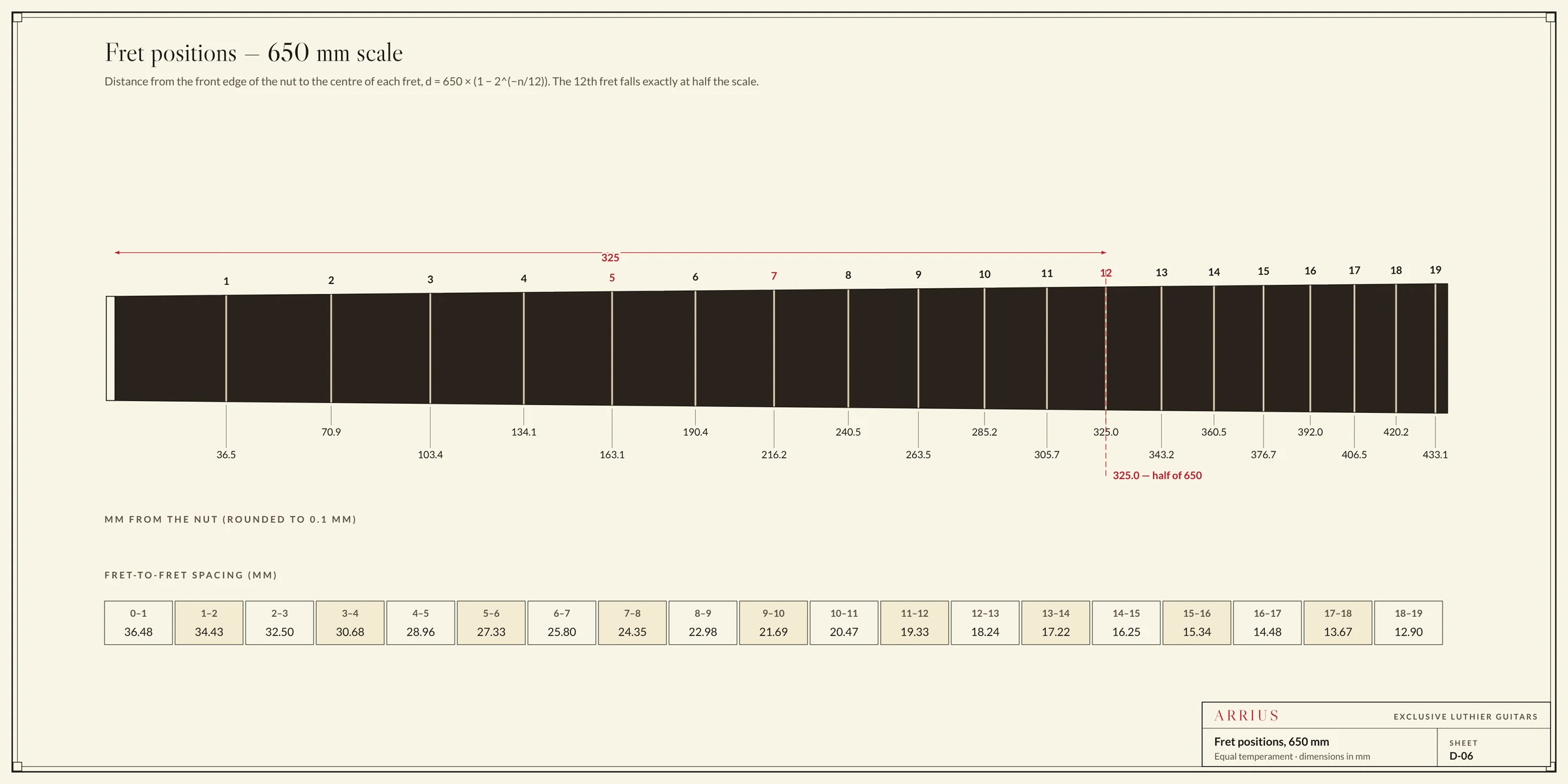
The distance from the front edge of the nut to fret n is d = L × (1 − 2−n/12), where L is the scale length. Each fret shortens the vibrating string by the same ratio, the twelfth root of two (about 1.0595), which raises the pitch by one equal-tempered semitone. The twelfth fret always falls exactly at half the scale: 325 mm on a 650 mm guitar.
Worth knowing: older workshop books speak of the “rule of eighteen”, dividing the remaining string length by 18 for each fret. It is a close approximation of the exact constant 17.817. Modern makers use the exact figure.
Fret position table
Distances in millimetres from the front edge of the nut to the centre of each fret, rounded to 0.1 mm. The spacing column shows the distance from the previous fret for a 650 mm scale.
| Fret | 650 mm | Spacing (650) | 640 mm | 630 mm |
| 1 | 36.5 | 36.48 | 35.9 | 35.4 |
| 2 | 70.9 | 34.43 | 69.8 | 68.7 |
| 3 | 103.4 | 32.50 | 101.8 | 100.2 |
| 4 | 134.1 | 30.68 | 132.0 | 130.0 |
| 5 | 163.1 | 28.96 | 160.5 | 158.0 |
| 6 | 190.4 | 27.33 | 187.5 | 184.5 |
| 7 | 216.2 | 25.80 | 212.9 | 209.5 |
| 8 | 240.5 | 24.35 | 236.8 | 233.1 |
| 9 | 263.5 | 22.98 | 259.5 | 255.4 |
| 10 | 285.2 | 21.69 | 280.8 | 276.4 |
| 11 | 305.7 | 20.47 | 301.0 | 296.3 |
| 12 | 325.0 | 19.33 | 320.0 | 315.0 |
| 13 | 343.2 | 18.24 | 338.0 | 332.7 |
| 14 | 360.5 | 17.22 | 354.9 | 349.4 |
| 15 | 376.7 | 16.25 | 370.9 | 365.1 |
| 16 | 392.0 | 15.34 | 386.0 | 380.0 |
| 17 | 406.5 | 14.48 | 400.3 | 394.0 |
| 18 | 420.2 | 13.67 | 413.7 | 407.3 |
| 19 | 433.1 | 12.90 | 426.4 | 419.8 |
What the numbers show
- The first fret is 36.5 mm from the nut; the nineteenth is only 12.9 mm from the eighteenth. Above the twelfth fret, spacing is half of what it is at the nut, which is why high positions demand such precision. Playing above the 12th fret.
- Shortening the scale by 10 mm moves the fifth fret by about 2.5 mm and the twelfth by 5 mm. Small numbers, but the hand feels them in every stretch.
- In practice, makers add a tiny compensation at the saddle and sometimes at the nut, because pressing a string to the fret also stretches it slightly. That is why the saddle is not set at exactly 650 mm on every string.
Drawing
The same positions are shown on our technical drawing of a 650 mm fingerboard.
All our classical guitars, from the Arrius MPR-5000 to the S-1000, use the 650 mm scale with a 52 mm nut. Why 650 mm became the standard · All specifications.