An Arrius is built to be played for decades, so sooner or later many of them change hands. This short guide shows what to look at before you buy one second-hand, or when you simply want to be sure about the instrument you own. None of the checks needs tools; a good light and a few minutes are enough.
1. The label inside the body
Look through the soundhole towards the back of the guitar. A genuine Arrius carries the house label: the words Exclusive Luthier Guitars, the Arrius name in red, the rosette ornament and the model name, for example S-1000. The label is glued flat and evenly to the inside of the back.
- The model name on the label should match the instrument you are holding.
- A label that is crooked, loose, printed on plain paper or missing altogether is a reason to ask questions.
2. The serial number
Every instrument has its own serial number in the form A035/2023: a letter and a number, then the year after the slash. The same number appears on the certificate that comes with the guitar.
3. The certificate and its seal
Each Arrius leaves the workshop with a printed certificate of authenticity and quality. Check that it carries:
- the serial number of the guitar;
- a holographic seal confirming a handmade instrument;
- the stamp and signature of quality control.
Keep the certificate with the guitar. It matters for the warranty, for insurance and, one day, for the next owner.
4. The build itself
Papers can be lost; the workmanship stays. These details hold for every Arrius:
- Solid wood only. Arrius never uses laminates. At the edge of the soundhole the grain of the top runs straight through the whole thickness, with no visible layers.
- Concert dimensions. The classical models have a 650 mm scale and a 52 mm nut.
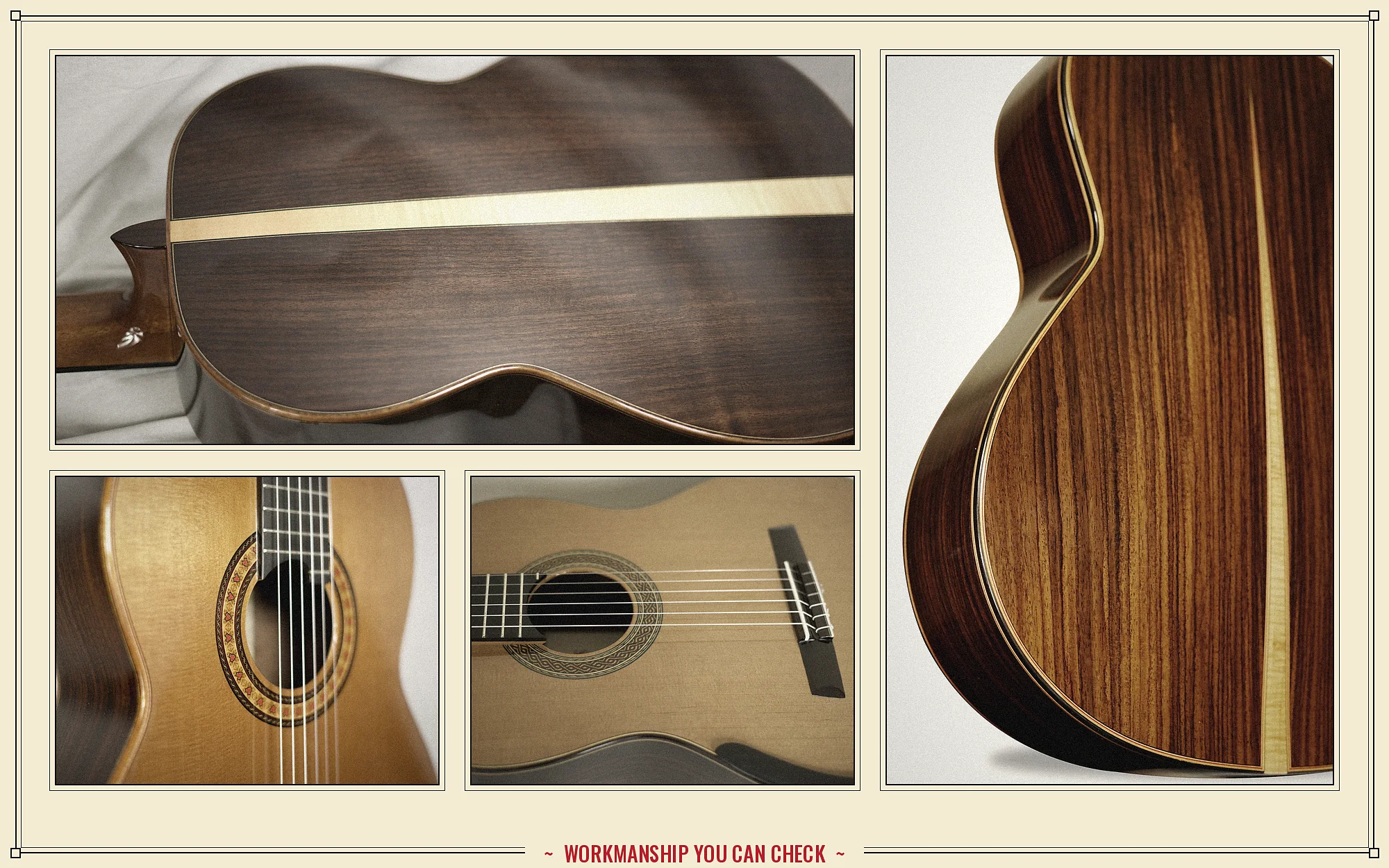
- Clean finishing. Bindings, purfling and the rosette are fitted without gaps, and the finish is even over the whole body.
- The right specification for the model. Compare the woods and fittings with the model pages: for example the S-1000 has a cedar and spruce double top, Indian rosewood with ziricote, an ebony fingerboard, a bone nut and saddle and gold 22:1 machine heads.
5. Buying second-hand
Ask the seller for the certificate and photographs of the label before you pay. An instrument sold without papers is not necessarily a fake, but it is always worth checking. If the model on the label, the serial number and the specification do not agree with one another, treat that as a warning.
Ask us to check
If you are unsure, write to us with the serial number, a photograph of the label and a photograph of the certificate. We will compare them with our records and reply.