An Arrius guitar is the result of a few firm decisions and a great many small ones. The firm decisions were made at the very beginning and have not moved since. The small ones are made every day, at the bench, by people who know that a classical guitar is judged one note at a time.
From Spain to America
The way we build is rooted in the Spanish school of guitar making, the tradition that gave the classical guitar its modern form. In 2014 we brought that experience to the United States of America. The reason was practical rather than romantic: here we have good access to the finest tonewoods, and the quality of the wood decides more about a guitar than any other single factor.
The instruments are made by hand by a small, experienced group of luthiers. Their work is supervised throughout by Spanish specialists, so that every guitar leaving the workshop speaks the same language as the instruments that inspired it. Engineers work alongside them, testing new constructions until a solution earns its place in a finished guitar.
Solid wood, and nothing else
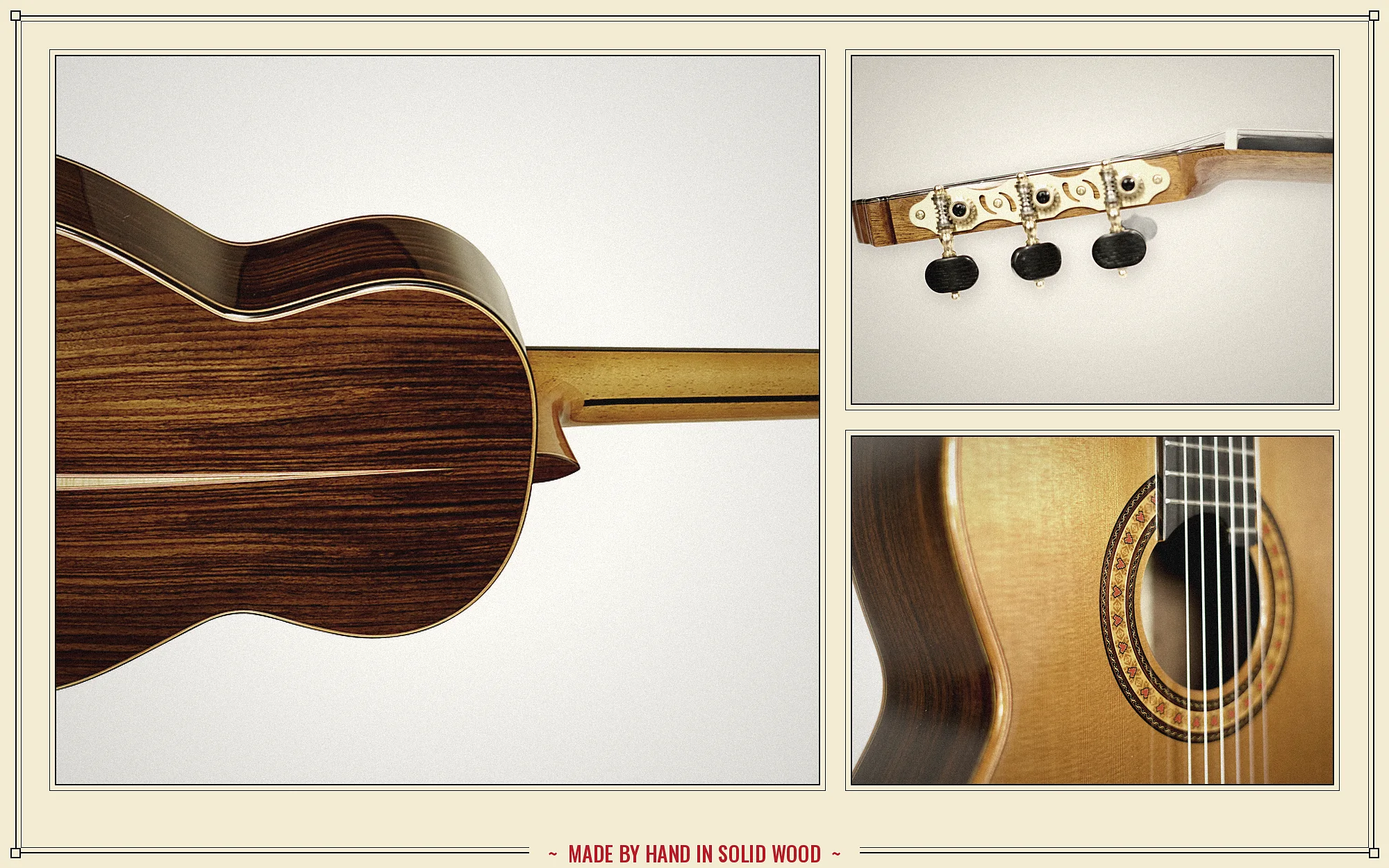
Every Arrius is built entirely of solid wood. A laminated top or back can be stable and inexpensive, but it cannot develop as solid wood does. A solid top opens up with playing; its response grows richer over the first months and years. We would not want to build an instrument that cannot do that.
Our wood comes from verified suppliers we have worked with for years, and it carries the certificates required for international trade in tonewoods. Before it is used, every piece is seasoned for a minimum of eight years. Seasoning lets the wood release its internal tension slowly and evenly. A top that has rested this long holds its shape through changes of season, which is why we can speak with confidence about the structural stability of our guitars over their whole working life.
The woods we choose
For soundboards we use Canadian cedar and spruce, in high grades with tight, even grain. Cedar gives a warm, immediate voice; spruce a clearer, more articulated one that grows with time. Our concert model, the S-1000, joins both in a double top.
For backs and sides we use Indian rosewood, the classic partner of a fine soundboard, and on selected models ziricote or Java ebony, which add depth and a striking figure. Necks are made of African mahogany or cedar, fingerboards, bridges and armrests of ebony, and nuts and saddles of bone. All of these meet in our master-grade MPR-5000 classical guitar.
Construction that serves the sound
We keep the outward look of our guitars close to the classical tradition. What changes from model to model is inside: the bracing, the reinforcements and the way vibration travels from the strings to the top. Over the years this work has given us constructions that add volume while keeping the standard dimensions of a concert guitar, 650 mm scale and 52 mm nut width, so that a player feels at home from the first chord.
A finish applied by hand
The finish is applied by a special manual method. It protects the wood while leaving it free to vibrate, and it brings out the natural character of each species. A luthier checks every instrument at each stage, and before a guitar is signed off it passes through quality control, which is confirmed on its certificate.
Milestones
- 2014 — we bring our Spanish experience to the United States, closer to the finest tonewoods.
- 2017 — the new version of the Arrius MPR-5000, our master-grade guitar, with its additional resonance port.
- 2018 — the MPR-100 S with a rounded cutaway, distinguished at trade fairs in Japan and Europe in its first year, and the UK-1500 ukulele.
- 2020 — the S-1000 with a Nomex double top of cedar and spruce, and the all-solid MPR-400.
For those who want more than a guitar
For our most demanding customers we prepare limited series and individual finishes. The best known is the M Diamond series, where the headstock is decorated with moissanite stones. On request we also fit details in gold and other precious materials. Such commissions are priced individually, according to the specification. See how to order.