Guitar makers and players use a language of their own. Some of its words are centuries old, some arrived with new materials only a few decades ago. This glossary explains the terms you will meet on our pages and in conversations about fine classical guitars, in plain words and without assuming technical knowledge. Where a term describes something you can see on an Arrius, we link to the model.
Jump to: Body and top · Inside the guitar · Neck and fingerboard · Fittings · Sound · Woods and finish · Care and setup
Body and top
Top (soundboard)
The front of the guitar, a thin plate of wood that turns the vibration of the strings into sound. It decides more of a guitar’s voice than any other part. On a fine classical guitar it is solid cedar or spruce, about 2 to 2.5 mm thick. Cedar or spruce?
Solid wood
Wood cut from a single piece of timber through its whole thickness, as opposed to laminate. Solid tops vibrate more freely and improve with playing. Every Arrius is made of solid wood only.
Laminate
Several thin layers of wood glued together, like plywood. Laminates are strong and cheap, but they vibrate less freely and do not age the way solid wood does. A look at the edge of the soundhole usually tells the two apart. How to recognise a genuine Arrius.
Double top
A soundboard made of two very thin skins of wood joined around a light core, usually of Nomex. It is stiffer and lighter than a solid top of the same thickness, which gives more volume, faster response and longer sustain. Our S-1000 has a double top of cedar and spruce. The double top explained.
Nomex
A heat-resistant aramid material, formed into a light honeycomb and used in aircraft panels. In guitar making it serves as the core of a double top: it adds stiffness while weighing almost nothing.
Upper bout, lower bout, waist
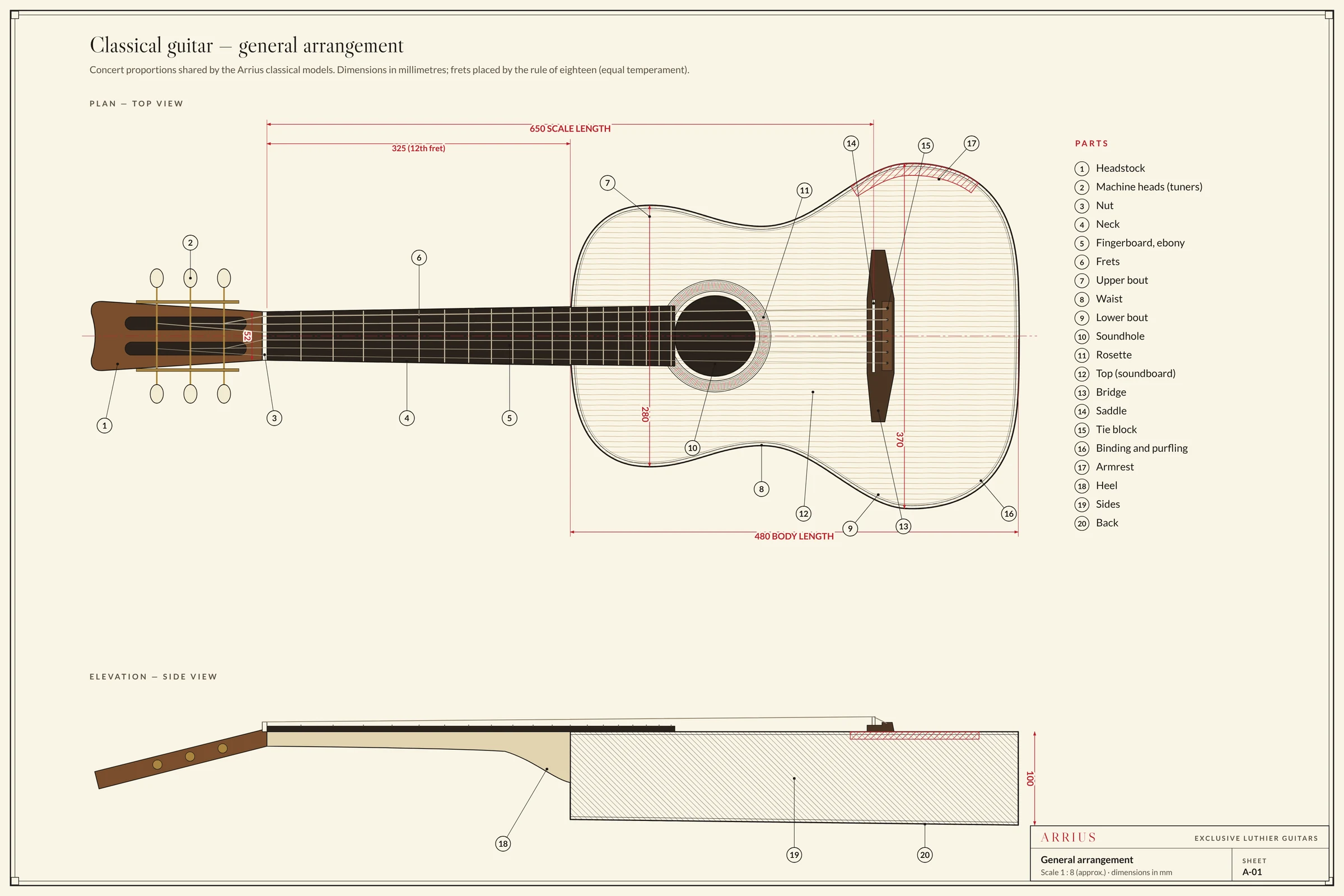
The upper bout is the smaller, upper part of the body near the neck; the lower bout is the larger part below the soundhole; the waist is the narrow curve between them. On our classical guitars the lower bout is 370 mm wide and the upper bout 280 mm.
Rosette
The decorative ring around the soundhole, traditionally a mosaic of tiny coloured wood pieces. It is the signature of a maker and also strengthens the edge of the hole.
Binding and purfling
Binding is the strip of wood (or another material) that runs around the edges of the body, protecting them and sealing the end grain. Purfling is the fine decorative line beside it. The MPR-5000 has an eight-layer binding of African rosewood and maple.
Cutaway
A section removed from the upper bout on the treble side, so the left hand can reach the highest frets. The MPR-100 S has a rounded cutaway.
Inside the guitar
Bracing
Thin wooden struts glued under the top and back. They keep the plates from collapsing under string tension and shape the way the top vibrates. Bracing is one of the main places where makers differ. Fan and lattice bracing.
Fan bracing
The traditional Spanish system: several thin braces spread like the ribs of a fan below the soundhole. It was refined by Antonio de Torres in the nineteenth century and is still the basis of most classical guitars.
Lattice bracing
A grid of very light braces, often reinforced with carbon fibre, that allows a thinner and lighter top. Made famous in the 1980s by the Australian luthier Greg Smallman. Lattice tops are typically louder and very robust; the MPR-100 S uses lattice reinforcement.
Harmonic bars
The stronger transverse braces that cross the top above and below the soundhole. They define the area of the top that vibrates most freely.
Linings (kerfing)
Strips glued inside the body where the sides meet the top and back, widening the gluing surface. Often notched (kerfed) so they can follow the curves of the sides.
Heel and Spanish heel
The heel is the block where the neck meets the body. In the Spanish heel the sides are slotted directly into the neck, the traditional way of joining a classical guitar.
Neck and fingerboard
Fingerboard
The flat strip on the neck into which the frets are set. On a fine guitar it is ebony: hard, dense and resistant to wear.
Raised (elevated) fingerboard
A fingerboard whose part over the body is lifted above the top instead of being glued to it. It gives comfortable access to the highest positions without a cutaway, and leaves the upper part of the top free of glue and load. The Arrius MPR-5000 has a raised ebony fingerboard. Read more.
Scale length
The vibrating length of the string, from the nut to the saddle. The concert standard for classical guitars is 650 mm. Why 650 mm.
Nut width
The width of the fingerboard at the nut. The classical standard is 52 mm, which gives room for clean left-hand technique.
Truss rod
A metal rod inside the neck that counteracts string tension. Steel-string guitars always have one; many classical guitars do not, because nylon strings pull with much less force.
Headstock (head)
The top end of the neck carrying the machine heads. On a classical guitar it is usually slotted. On Arrius limited series it can be set with Swarovski crystals, moissanite or diamonds.
Fittings
Armrest
A bevel, usually of ebony or rosewood, fitted on the edge of the lower bout where the right forearm rests. It keeps the arm off the soundboard so the top vibrates freely, makes long playing more comfortable and protects the finish from sweat and wear. Found on the MPR-5000, S-1000, MPR-400 and MPR-100 S. Read about the armrest.
Bridge and tie block
The bridge is glued to the top and carries the saddle; the tie block behind it is where the strings are knotted. The bridge transmits the energy of the strings to the soundboard, which is why it is made of a hard wood such as ebony or rosewood.
Nut and saddle
The two points on which the strings rest at either end of their vibrating length. Bone is the traditional material: dense and hard, it transmits vibration better than plastic.
Machine heads (tuners)
The geared mechanisms that tune the strings. The ratio, for example 22:1, tells you how many turns of the button make one turn of the roller; the higher the number, the finer the tuning.
Soundport (resonance port)
An additional opening, usually in the upper side of the body facing the player. It lets the player hear more of the guitar’s sound, which a traditional soundhole sends forward to the audience. The Arrius MPR-5000 has an additional resonance port. Read about the soundport.
Sound
Projection
How well the sound of a guitar carries to the back of a room. Projection is not the same as loudness close to the instrument: some guitars sound loud to the player and fade a few metres away, others the opposite.
Sustain
How long a note keeps sounding after it is played. Dense back woods and a light, stiff top tend to lengthen sustain.
Response
How quickly and easily a guitar speaks when a string is played. Cedar tops are known for an immediate response.
Separation (clarity)
How clearly the individual voices of a chord or a contrapuntal passage can be heard. Valued especially in Baroque music.
Wolf tone
A note that sounds noticeably louder, weaker or unstable compared with its neighbours, because it coincides with a strong resonance of the body. Makers work to keep wolf tones small and evenly placed.
Tone colour
The quality of a sound that is neither pitch nor loudness: warm, dark, bright, nasal, sweet. Classical guitarists change it by moving the right hand towards the bridge (brighter) or the fingerboard (warmer).
Woods and finish
Tonewood
Wood selected for its acoustic qualities. The main classical tonewoods are cedar and spruce for tops, and rosewood, ebony, ziricote, mahogany, maple and cypress for backs and sides. Our tonewood library.
Seasoning
Slow, natural drying of wood over years, so it reaches a stable moisture content and stops moving. Every piece of wood in an Arrius is seasoned for at least eight years. Why we wait.
Quartersawn
Wood cut so that the growth rings run perpendicular to the surface of the board. Quartersawn wood is more stable and stiffer across the grain, which is why tops and backs are cut this way.
Grade (AAA, master grade)
A judgement of the quality of a piece of tonewood: straightness and density of grain, uniform colour, absence of defects. AAA is the highest common commercial grade; makers often use their own terms such as special or master grade.
French polish
A traditional finish of shellac applied by hand in many very thin layers with a cloth pad. It is thin and light, and it lets the top vibrate freely, but it is softer than modern lacquers. French polish or lacquer?
Lacquer
A modern finish, sprayed in layers and polished. It is harder and more protective than shellac; a well-applied thin lacquer can sound very good.
Care and setup
Action
The height of the strings above the frets, usually measured at the twelfth fret. Low action is easier to play; slightly higher action allows a stronger right hand without buzzing. Action and setup explained.
Relative humidity
The amount of moisture in the air compared with the maximum it can hold at that temperature. Solid-wood guitars are happiest between about 45% and 55%. Humidity through the seasons.
String tension
The force with which a string pulls when tuned to pitch. Classical strings come in normal, high (hard) and sometimes extra-high tension. Choosing strings.
Serial number and certificate
Every Arrius has its own serial number, recorded on a certificate of authenticity and quality with a holographic seal. How to check them.
Missing a term? Ask us, and we will add it to the glossary.