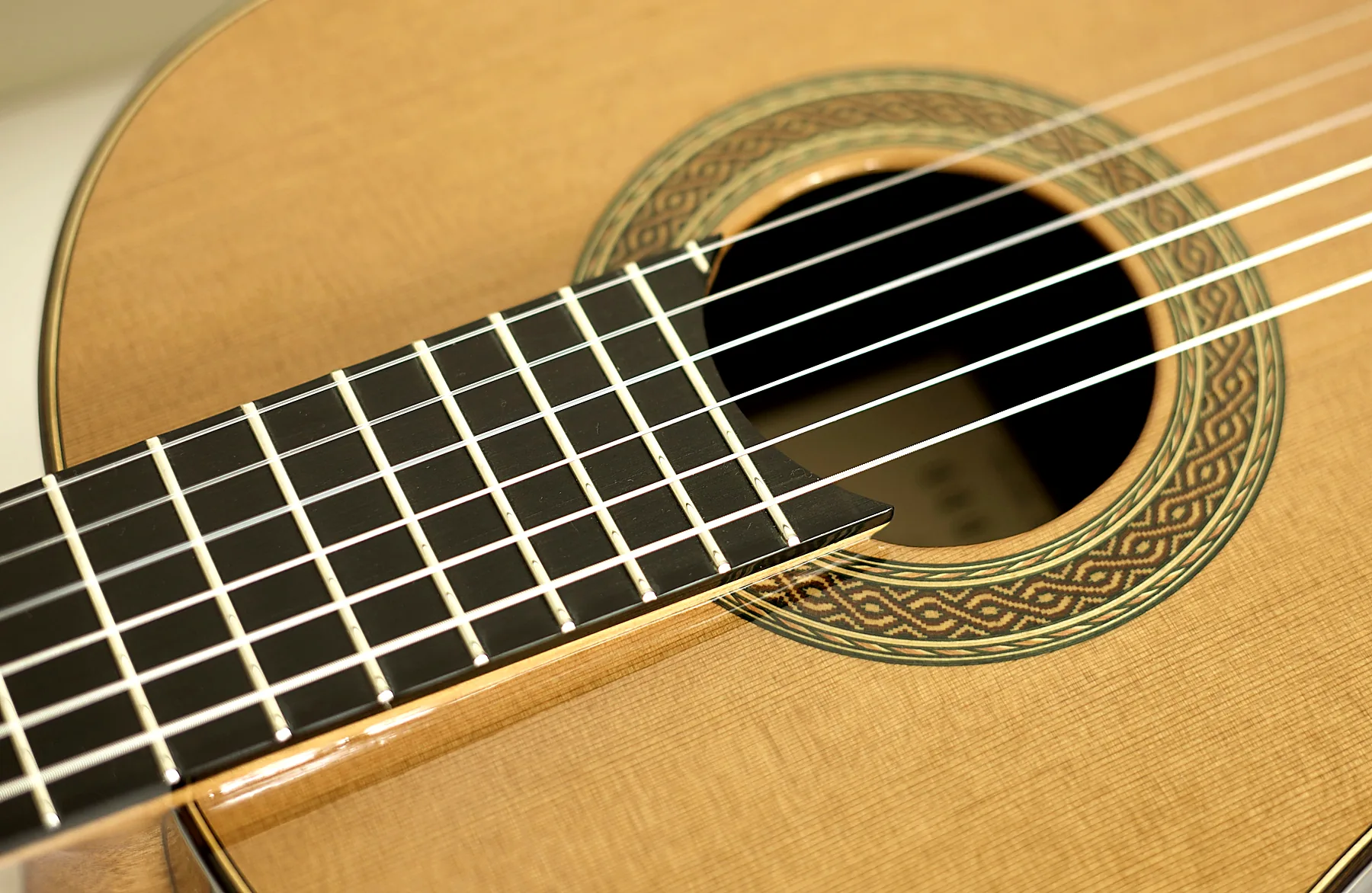
Look along the neck of most classical guitars and you will see the fingerboard run straight onto the top, glued flat to the soundboard all the way to the soundhole. On a guitar with a raised fingerboard, that last part floats a few millimetres above the top. It is a small difference to the eye, and a large one under the hand.
The problem it solves
On a traditional classical guitar the neck joins the body at the twelfth fret. Above that point the left hand has to reach around the shoulder of the upper bout, the thumb loses its support behind the neck, and the wrist bends at an awkward angle. Much of the repertoire stays below the twelfth fret for exactly this reason. But much does not: Barrios, Villa-Lobos, Britten, Brouwer and countless contemporary composers ask the guitarist to climb.
Makers have answered in two ways. One is the cutaway, which removes part of the upper bout. The other is the raised, or elevated, fingerboard.
How a raised fingerboard works
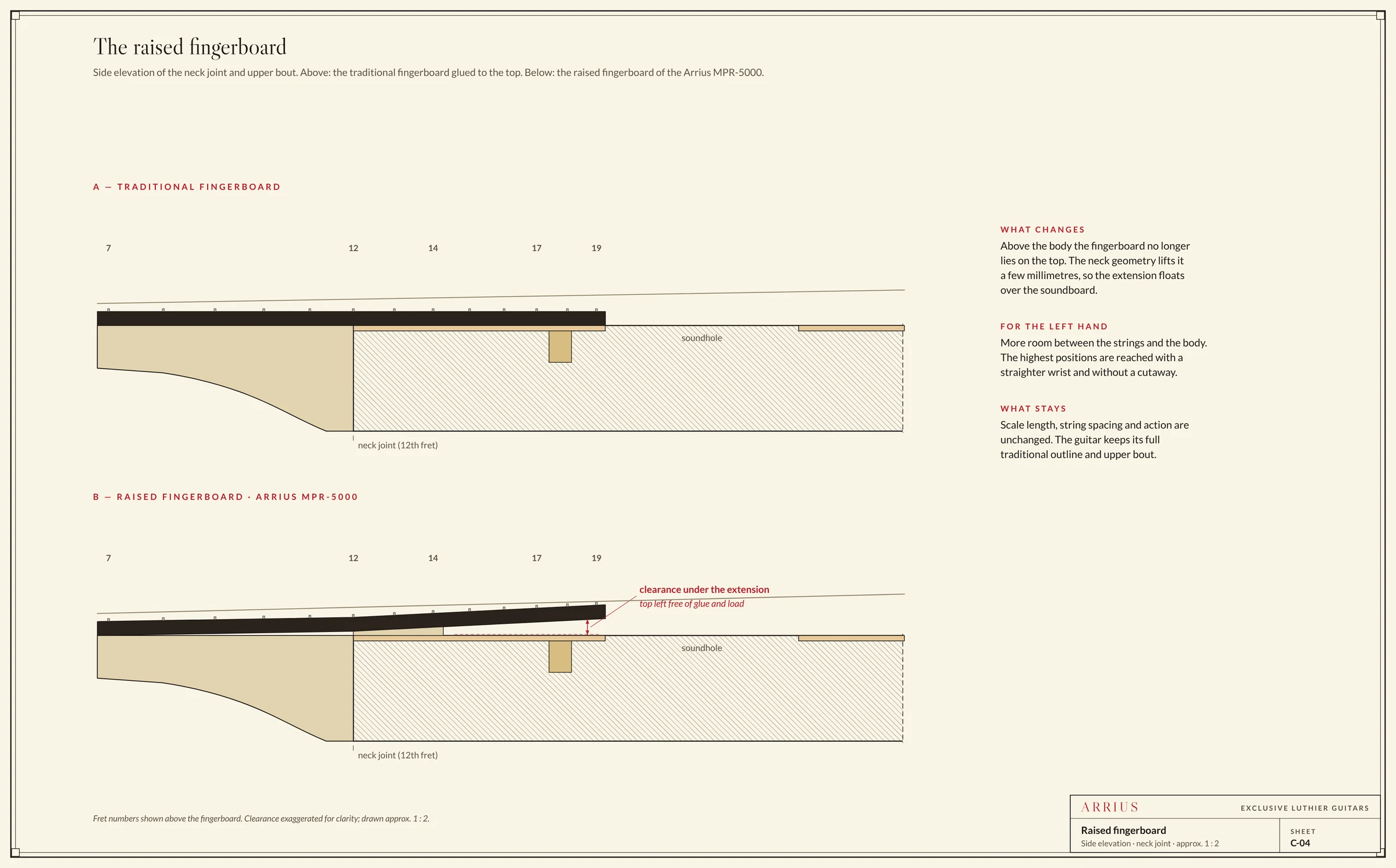
The neck is set at a slightly different angle, or the fingerboard extension is built up, so that the part of the fingerboard over the body sits above the top instead of on it. The strings still pass over the saddle at the usual height, and the scale and string spacing do not change. What changes is the geometry around the left hand: there is more room between the strings and the body, and the high positions feel closer and more open.
Worth knowing: makers build raised fingerboards in different ways, some by changing the neck angle, some by reshaping the upper bout. The result for the player is similar; the details are part of each maker’s signature.
What it gives the player
- Easier high positions. The left hand reaches the frets above the twelfth with less stretching and a more natural wrist.
- A traditional outline. Unlike a cutaway, the full body is kept. The guitar looks like a classical guitar and keeps the air volume of its upper bout.
- Comfort for the right hand too. Several makers note that the extra distance between the strings and the top gives the right hand a little more room.
Does it change the sound?
Here opinions differ, and it is fair to say so. The part of the top under a raised fingerboard is no longer loaded and glued; in principle it is freer to vibrate. Some makers believe this adds a little sustain or openness; others think the difference is too small to hear. What nobody disputes is that the raised fingerboard does not take sound away, which a badly drawn cutaway can do.
Our own view is practical: a feature that makes the guitar easier to play makes the player sound better, and that is a difference everyone hears.
Who it is for
A raised fingerboard is valuable for anyone whose music regularly goes above the twelfth fret, for players with smaller hands, and for those who want comfort without giving up the traditional shape of the guitar. It does not ask you to change your technique; most players simply notice that the high positions have become friendlier, and stop thinking about it.
In the Arrius collection
The Arrius MPR-5000 has a raised ebony fingerboard, combined with an additional resonance port and a solid ebony armrest. If you prefer a cutaway, the MPR-100 S opens the upper frets with a rounded cutaway and a lattice-braced top. The MPR-400 keeps the traditional fingerboard laid on the top.
More construction terms are explained in our classical guitar glossary.
Read next
- Playing above the 12th fret
- The soundport: hearing what the audience hears
- The armrest on a classical guitar
Our key instrument: the Arrius MPR-5000, master-grade cedar and rosewood guitar with a resonance port, raised fingerboard and ebony armrest. More in the knowledge base.