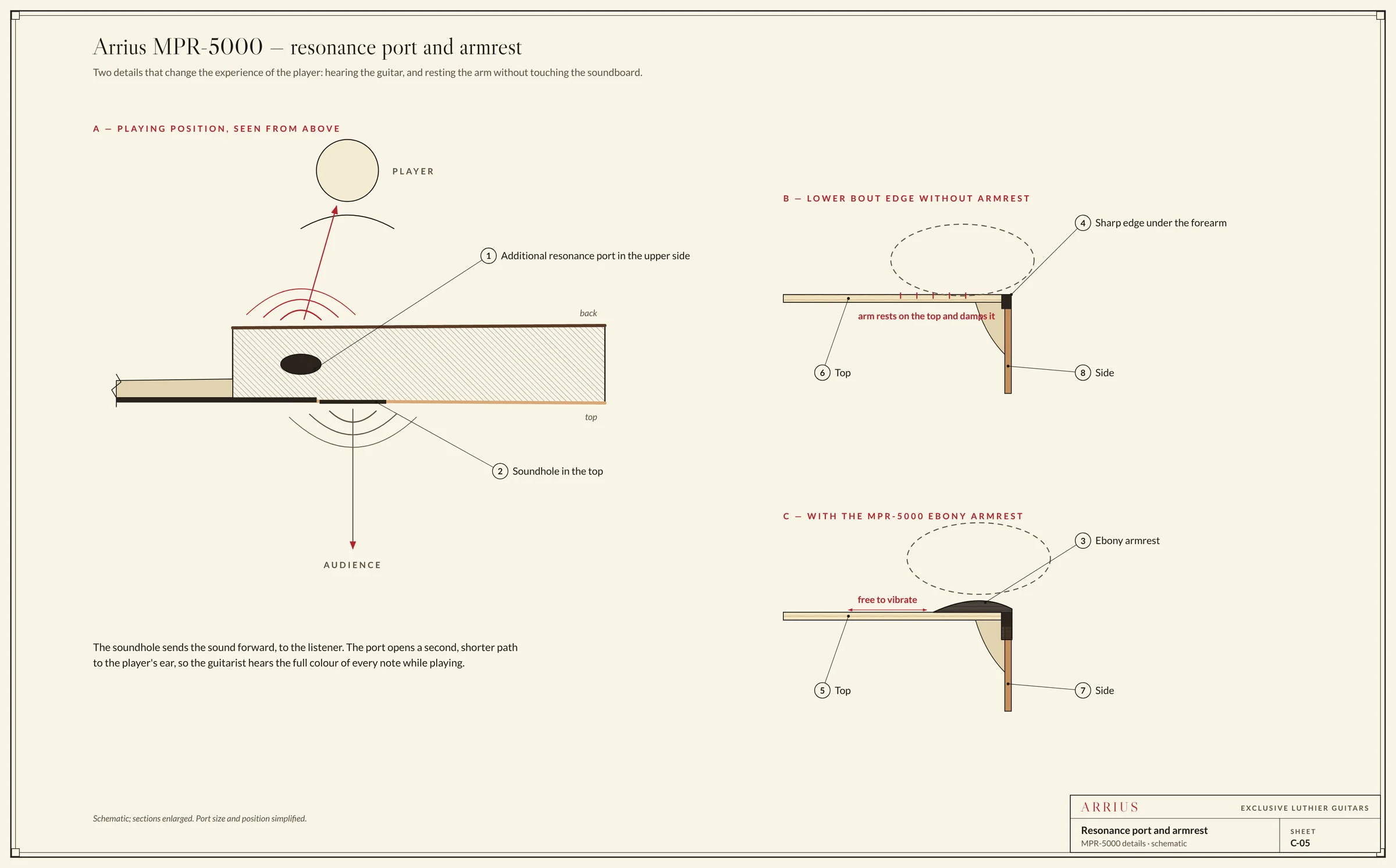
There is a strange fact about the classical guitar that most players accept without thinking: the person who hears the instrument least well is the one playing it. The soundhole faces forward, towards the audience. The player sits behind the top, listening from the side, and hears a smaller, duller version of the sound that fills the room.
The idea of a second opening
A soundport, or resonance port, is an additional opening in the body, usually in the upper side of the guitar facing the player. Through it some of the sound inside the body reaches the player’s ear directly. The traditional soundhole keeps doing its work; the port adds a second, private window onto the sound.
Ports have been used by individual makers for decades and have become common on modern concert guitars. Their size, shape and position vary from maker to maker, and each affects the result.
What changes for the player
- You hear the colour of every note. Nuances of tone, vibrato and dynamics that were obvious to the audience but faint behind the guitar become audible to you.
- You practise better. Players adjust what they hear. If you hear more precisely, you shape phrases more precisely.
- You play more easily in ensembles. In chamber music, where other instruments surround you, hearing your own guitar clearly helps you balance and blend.
- You play with less force. When the guitar sounds full to you, there is less temptation to push it.
A note from us: the first minutes with a soundport can be a surprise. Many players say their guitar suddenly sounds “bigger”, although the audience hears much the same. What has changed is not the guitar but the player’s seat in the hall.
Does the audience lose anything?
A well-designed port is small compared with the soundhole and is placed so that it does not weaken the structure of the side. The audience continues to hear the guitar through the main soundhole. Some makers believe a port can also add a little volume or change the balance of the body’s resonances; this depends strongly on the design. The main purpose remains the player’s experience.
Can you cover it?
Some players cover the port with a small plug when they want the traditional experience, for example to compare. Most, once used to hearing their guitar properly, leave it open.
The resonance port on the Arrius MPR-5000
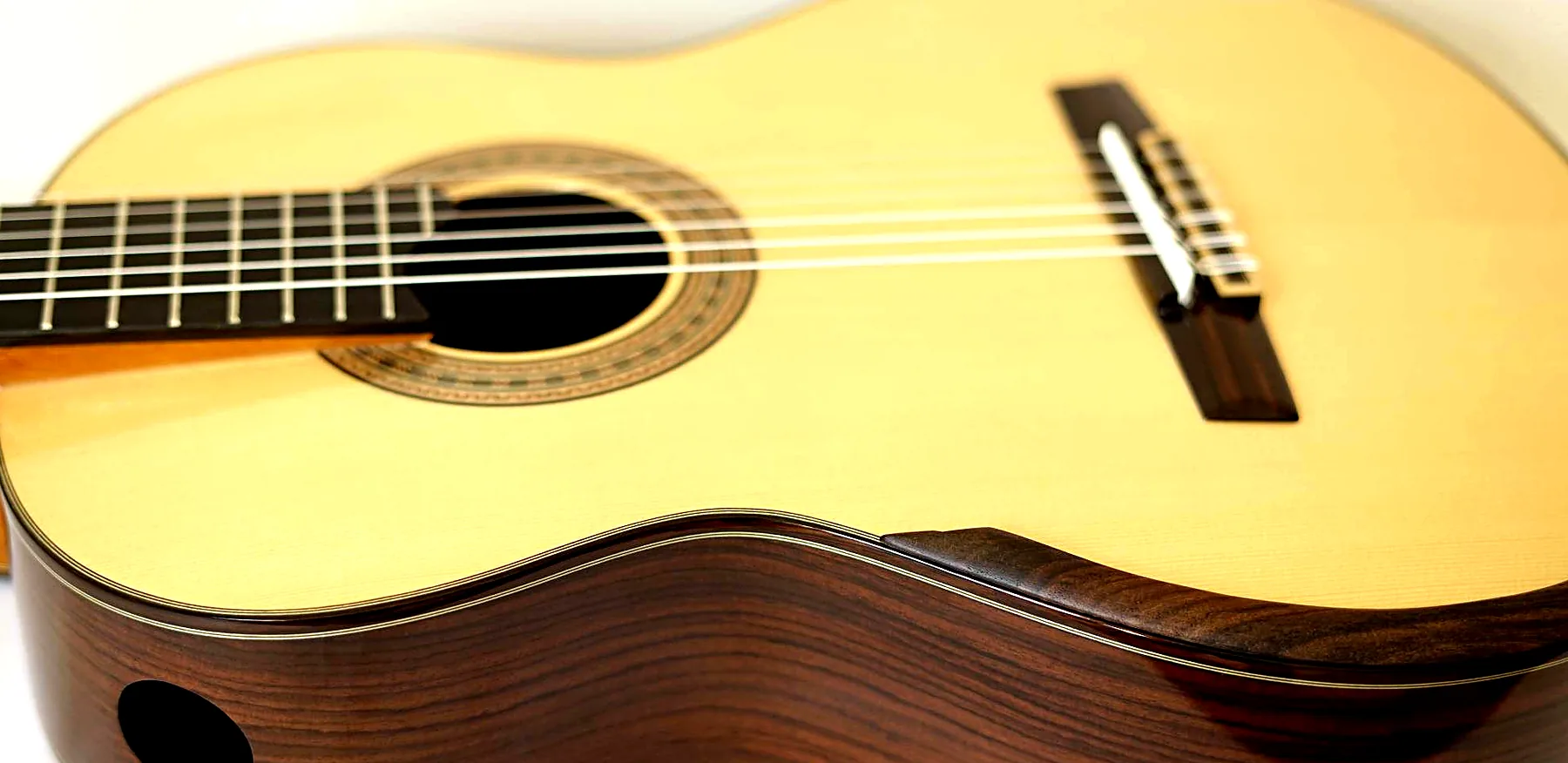
The Arrius MPR-5000 has an additional resonance port in the upper side, part of our sound-projection system. Combined with its special-grade cedar top, its raised fingerboard and its ebony armrest, it makes the MPR-5000 the most player-friendly guitar in our collection. If you prefer the sound focused entirely towards the listener, in the traditional way, the MPR-400 keeps a single soundhole.
See also: the raised fingerboard · soundport in the glossary.
Read next
- The raised fingerboard: why lift it above the top
- The armrest on a classical guitar
- How to choose a concert classical guitar
Our key instrument: the Arrius MPR-5000, master-grade cedar and rosewood guitar with a resonance port, raised fingerboard and ebony armrest. More in the knowledge base.