A fine guitar is easier to choose, play and keep when you understand how it is made. This knowledge base gathers everything we have written about classical guitars: how to choose one, what the woods and constructions do, how to care for an instrument, and the words makers and players use. Start wherever your question is.
Choosing a guitar
- How to choose a concert classical guitar — a step-by-step guide: where you play, what you play, which voice you love, and how to test a guitar in ten minutes.
- The Arrius collection compared — woods, constructions and character of every model side by side.
- Arrius MPR-5000 — our master-grade guitar, described part by part: cedar and rosewood, resonance port, raised fingerboard and armrest.
- Specifications — every model side by side, with PDF data sheets.
- Questions and answers — what players and music shops ask us most often.
Woods
- Tonewood library — cedar, spruce, Indian rosewood, ziricote, Java ebony, mahogany, maple and ebony, with what each gives the sound.
- Cedar or spruce: what the soundboard decides
- Rosewood, ziricote and Java ebony for back and sides
- Why tonewood is seasoned for years
Construction
- The double top explained
- Fan bracing and lattice bracing
- The raised fingerboard: why lift it above the top
- The soundport: hearing what the audience hears
- The armrest on a classical guitar
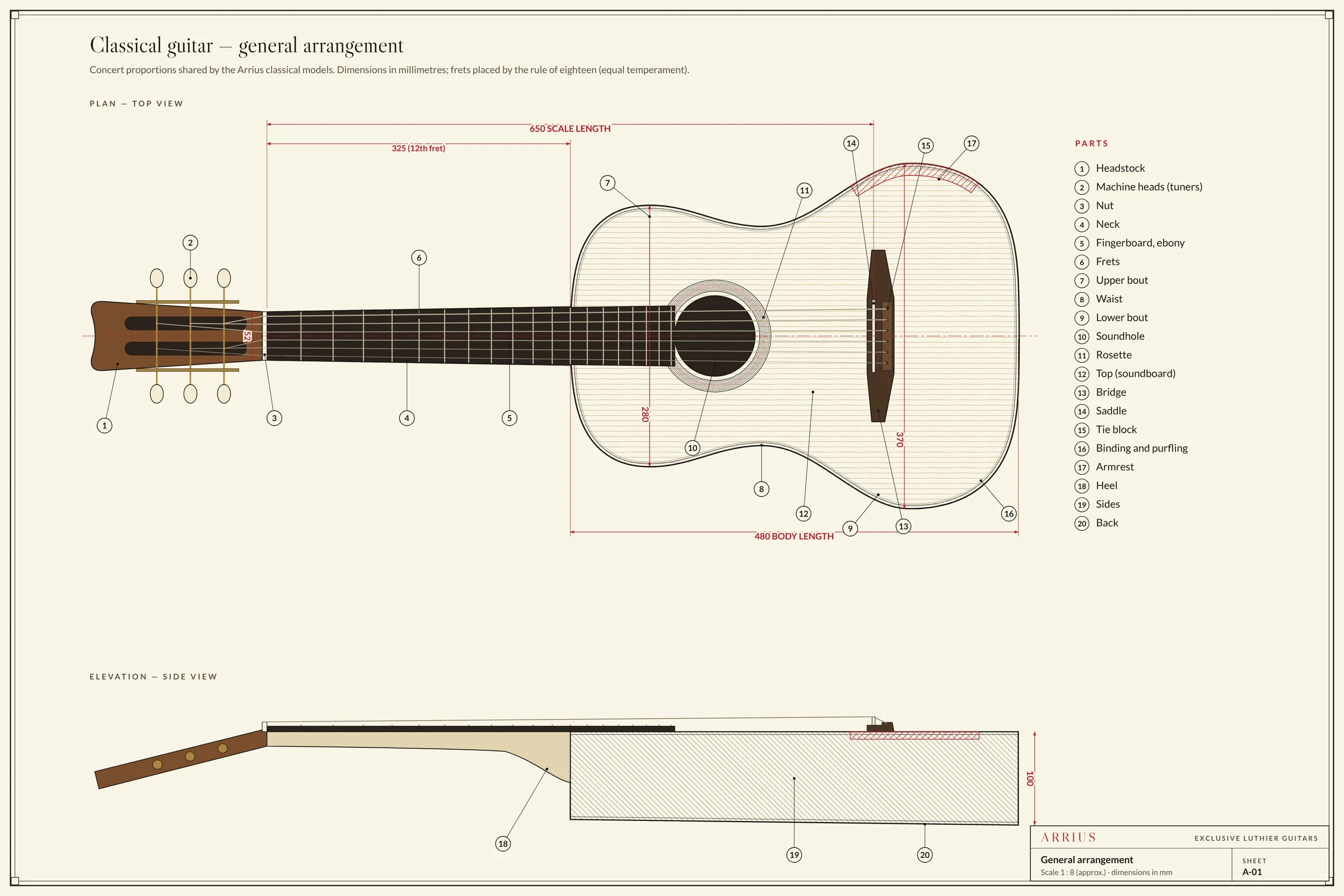
- 650 mm scale and 52 mm nut: why the standard
- Fret positions for a 650 mm scale — table and drawing
- Playing above the 12th fret
- French polish or lacquer?
- How we build an Arrius
Playing and care
- Caring for your instrument — humidity, temperature, cleaning, strings and storage.
- Guitar humidity through the seasons
- Choosing strings for a concert classical guitar
- Action and setup of a classical guitar
- Recognising a genuine Arrius
History
- Antonio de Torres and the modern classical guitar
- How cedar came to the classical guitar
- Greg Smallman and the lattice guitar
Words
The classical guitar glossary explains more than forty terms in plain language, from armrest and double top to wolf tone.
Five facts worth remembering
| 650 mm | The concert scale length of a classical guitar, the vibrating length of the string from nut to saddle. |
| 52 mm | The standard nut width, which gives room for clean left-hand technique. |
| 45–55% | The relative humidity in which a solid-wood guitar is most comfortable. |
| 8 years | The minimum seasoning time of every piece of wood in an Arrius. |
| 22% | How much more volume our concert constructions allow while keeping the standard dimensions. |
Cannot find what you need? Ask us; good questions often become new articles in the journal.