Two guitars of the same model can feel completely different under the hands, and very often the reason is not the wood or the construction but a few tenths of a millimetre of string height. This is the setup, and it is the part of a guitar that the player can most easily have changed.
What action means
Action is the height of the strings above the frets. It is usually measured at the twelfth fret, from the top of the fret to the bottom of the string, separately on the first string (high E) and the sixth (low E). The bass strings sit a little higher than the trebles because they vibrate in a wider arc.
Typical values
| Setup | 1st string at 12th fret | 6th string at 12th fret |
| Low | about 2.8 mm | about 3.6 mm |
| Medium | about 3.0–3.2 mm | about 3.8–4.0 mm |
| High | about 3.5 mm | about 4.5 mm |
These are common reference points, not rules. Every maker and every player has preferences.
The trade-off
- Lower action is easier for the left hand, especially in barrés and high positions. But a strong right hand may cause buzzing against the frets.
- Higher action allows a powerful attack and gives a fuller, more projecting tone, at the cost of more effort for the left hand.
A note from us: if a guitar feels hard to play, check the action before you blame the guitar. A tenth of a millimetre at the twelfth fret is two tenths at the saddle, and it can change everything about how a guitar feels.
Why action changes with the seasons
Solid wood moves with humidity. In damp weather the top swells and rises slightly, lifting the action; in dry weather it sinks, and the action falls. A guitar that buzzes in winter may feel stiff in summer. Keeping the humidity steady, about 45–55%, keeps the setup steady too. Guitar humidity through the seasons.
How action is adjusted
On a classical guitar, action is changed mainly at the saddle. To lower it, a luthier takes material from the bottom of the saddle; to raise it, a new, taller saddle is made or a shim is added. The height at the nut affects the first frets and is adjusted separately. Because most classical guitars have no adjustable truss rod, neck relief is set by the maker.
Do it yourself?
We advise against it. A saddle filed unevenly can rock in its slot, lose contact with the bridge and rob the guitar of sound, and material taken off cannot be put back. Ask a qualified luthier, and bring a note of what you want to change and why.
Strings matter too
Higher-tension strings feel firmer and can tolerate a slightly lower action; normal-tension strings feel softer but may need a little more height to avoid buzzing. Choosing strings.
Setup on a raised fingerboard
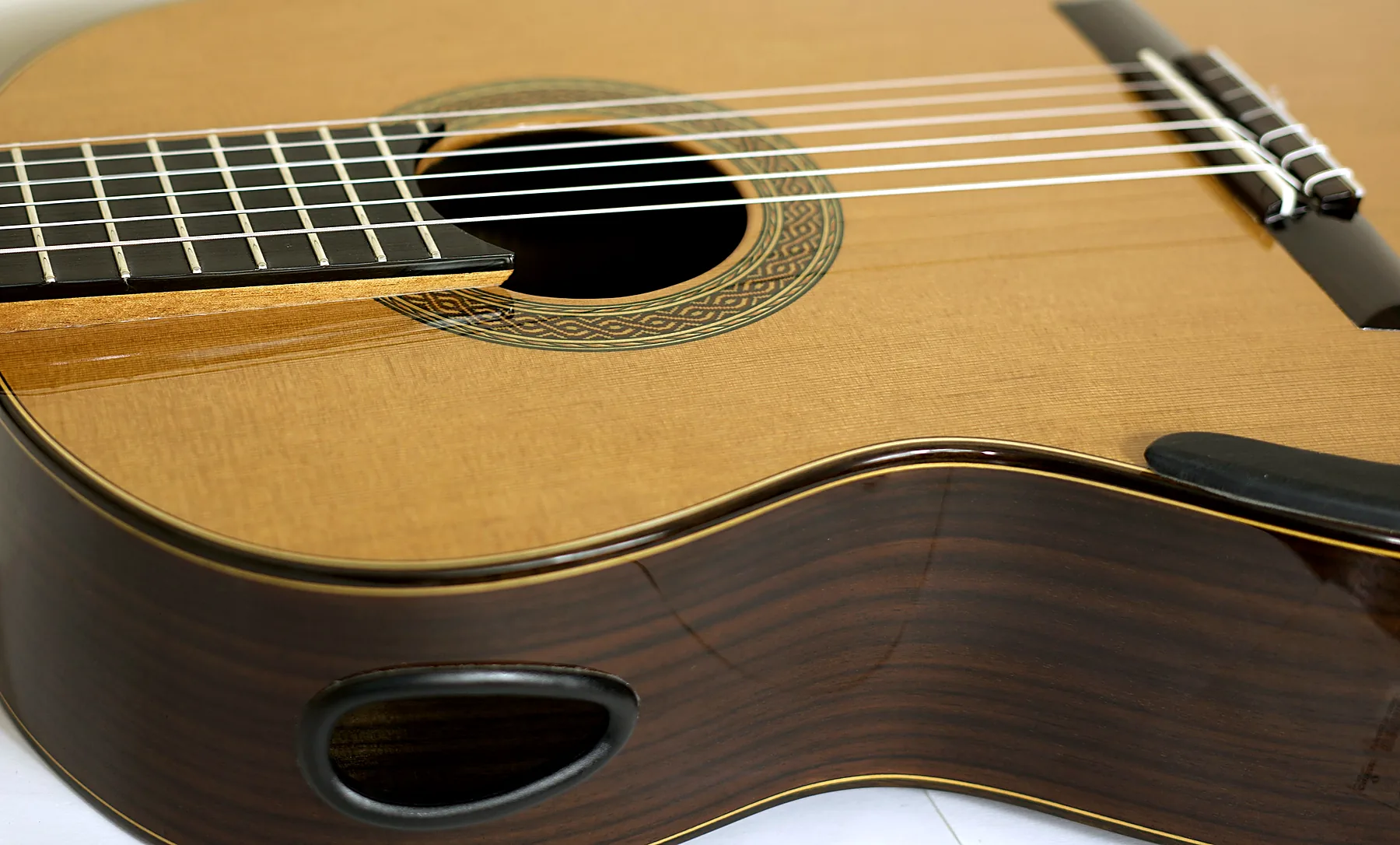
On a guitar with a raised fingerboard, such as the Arrius MPR-5000, the action is measured and adjusted in exactly the same way. The raised fingerboard changes the geometry around the left hand in the high positions, not the height of the strings above the frets. Read about the raised fingerboard.
Read next
- Choosing strings for a concert classical guitar
- Keeping a concert guitar through the seasons
- The raised fingerboard: why lift it above the top
Our key instrument: the Arrius MPR-5000, master-grade cedar and rosewood guitar with a resonance port, raised fingerboard and ebony armrest. More in the knowledge base.