Above the twelfth fret the classical guitar becomes a different instrument. The frets are narrow, the strings feel looser under the fingers, the body of the guitar is in the way of the hand, and every note is exposed. These are often the climactic moments of a piece, and they are where many players feel least secure.
Why the high positions are hard
- Narrow frets. Above the twelfth fret the spacing between frets is half of what it is at the nut. Small inaccuracies become buzzes or dead notes. See the fret spacing for a 650 mm scale.
- The body in the way. On a traditional guitar the neck joins the body at the twelfth fret. To go higher, the hand must arch over the upper bout and the thumb loses its place behind the neck.
- Exposure. High notes stand out. The audience hears every imperfection.
Music that goes there
Much of the core repertoire climbs above the twelfth fret: passages in Britten’s Nocturnal after John Dowland, the first-string ornaments of Rodrigo’s Concierto de Aranjuez, many of the Villa-Lobos studies, and countless arrangements that place a melody high on the first string. Contemporary music often uses the whole length of the fingerboard.
How players manage
Teachers describe several practical habits for the high positions. The guitarist Douglas Niedt, for example, recommends experimenting between a hand position parallel to the frets and a slanted one, keeping the thumb in contact with the guitar, letting the heel of the hand rest on the upper bout as a support rather than an obstacle, and moving the hand away from the neck gradually as it ascends. None of these replaces slow, careful practice.
A note from us: practise high passages softly first. A light touch shows where the fingers are imprecise; a strong one hides it until the concert.
How the guitar can help
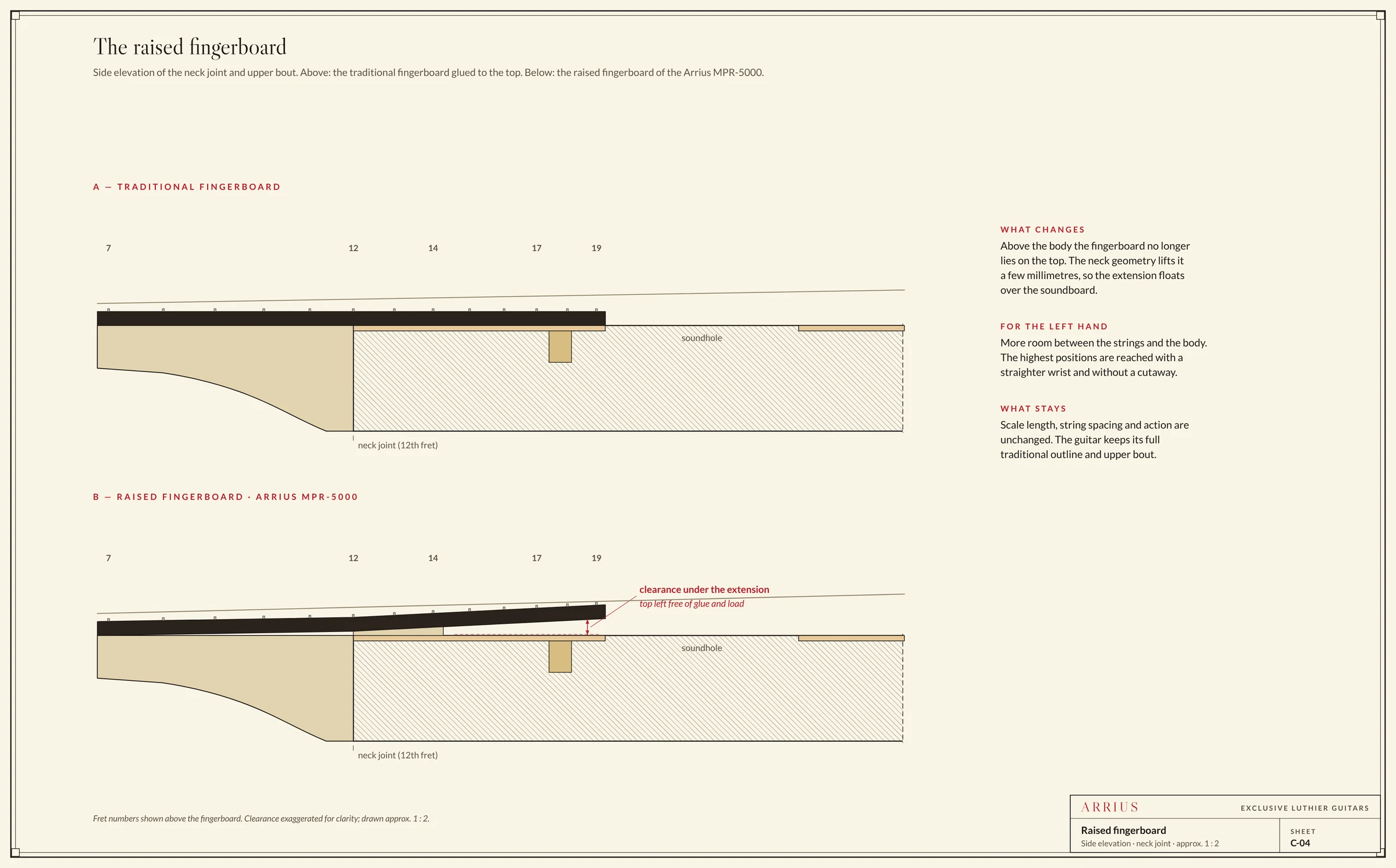
Makers have two ways of giving the left hand more room. A cutaway removes part of the upper bout on the treble side. A raised fingerboard lifts the fingerboard above the top, so the strings and frets stand further from the body while the traditional outline is kept. Neither changes the music; both make it more comfortable to play.
| Cutaway | Raised fingerboard | |
| Access to the highest frets | Very free | Free |
| Body outline | Changed | Traditional |
| Upper bout air volume | Reduced | Kept |
| In the Arrius collection | MPR-100 S | MPR-5000 |
The Arrius MPR-5000 combines a raised ebony fingerboard with a full traditional body and an additional resonance port, so you hear the high notes clearly while you play them. Read about the raised fingerboard.
Further reading
- Douglas Niedt — Playing in high positions
- Elevated fingerboards on classical guitars — This Is Classical Guitar
Read next
- The raised fingerboard: why lift it above the top
- Fret positions for a 650 mm scale
- 650 mm scale and 52 mm nut: why the standard
Our key instrument: the Arrius MPR-5000, master-grade cedar and rosewood guitar with a resonance port, raised fingerboard and ebony armrest. More in the knowledge base.