Every classical guitar built today, including ours, owes something to a carpenter from Almería. Antonio de Torres Jurado was born in 1817 near Almería and died there in 1892. In those 75 years he gave the Spanish guitar the proportions, the construction and much of the voice it still has. It is not an exaggeration to say that when you pick up a concert classical guitar, you are holding a descendant of his work.
From carpenter to guitar maker
Torres was apprenticed as a carpenter at the age of twelve. He made a few guitars in the 1840s, but he took up guitar making as a profession only in the 1850s, encouraged by the guitarist Julián Arcas. His working life falls into two periods: the first in Seville, from 1852 to 1870, and the second back in Almería, from the early 1870s until his death.
What he changed
- A larger body. Torres enlarged the guitar, especially the lower bout, giving it more air and a deeper bass.
- A thinner, lighter top. His soundboards were thin and lightly domed in both directions, which let them respond quickly and sing.
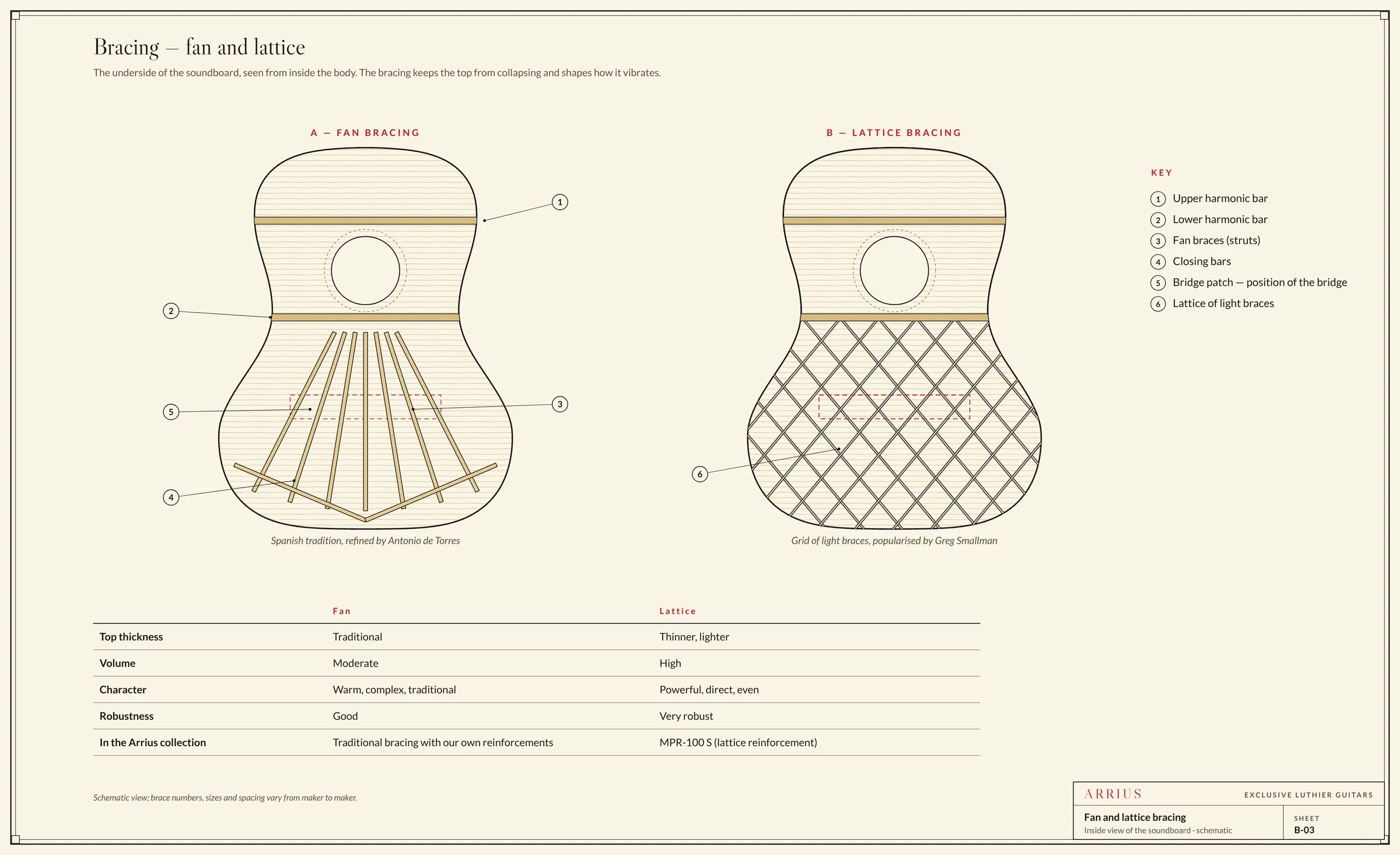
- Refined fan bracing. He did not invent fan bracing, but he refined it into the balanced, symmetrical pattern of thin struts that became the standard of the Spanish guitar.
The proportions he settled on, with a vibrating string length close to 650 mm, became the reference for the concert instrument. Our own guitars still follow them: a 650 mm scale and a traditional body outline. Why 650 mm became the standard.
The papier-mâché guitar
In 1862 Torres built a guitar with back and sides of papier-mâché and a fine spruce top. His aim was to show that the voice of the instrument comes above all from the soundboard. The guitar still exists and is held by the Museu de la Música in Barcelona.
A note from us: the experiment is often told as “the back does not matter”. That is not quite what it proves. It shows that the top is the heart of the sound, which every maker since has agreed with. The back and sides still colour the voice, as anyone who has compared rosewood and maple guitars can hear.
Tárrega and the Torres guitar
The young Francisco Tárrega met Torres around 1868 and acquired one of his guitars in Seville in 1869. Tárrega’s playing and teaching spread the Torres guitar, and with it the modern classical technique, across Spain and beyond. Torres guitars are still played today; one of the most famous, known as “La Leona”, is dated 1856.
What Torres left to modern makers
Almost every later development, from the larger concert guitars of the twentieth century to double tops and lattice bracing, began as a conversation with Torres. Makers kept his outline and changed what was inside. That is also our approach: a traditional exterior and a modern interior, as in the Arrius MPR-5000 with its resonance port and raised fingerboard, or the S-1000 with its double top. Read about fan and lattice bracing.
Further reading
- Antonio de Torres Jurado — Wikipedia
- The Spanish Guitar — The Metropolitan Museum of Art
- 6 Noteworthy Antonio de Torres Guitars — Classical Guitar Magazine
- José L. Romanillos, Antonio de Torres, Guitar Maker — His Life and Work
Read next
- Fan bracing and lattice bracing: the hidden architecture
- How cedar came to the classical guitar
- 650 mm scale and 52 mm nut: why the standard
Our key instrument: the Arrius MPR-5000, master-grade cedar and rosewood guitar with a resonance port, raised fingerboard and ebony armrest. More in the knowledge base.