If Torres defined the classical guitar of the nineteenth century, one of the makers who most influenced the concert guitar of the late twentieth was an Australian working far from the Spanish tradition. Greg Smallman, born in 1947, built his guitars in New South Wales and later in Western Australia, and he asked a simple question: how light can a soundboard be?
The idea: a very light top
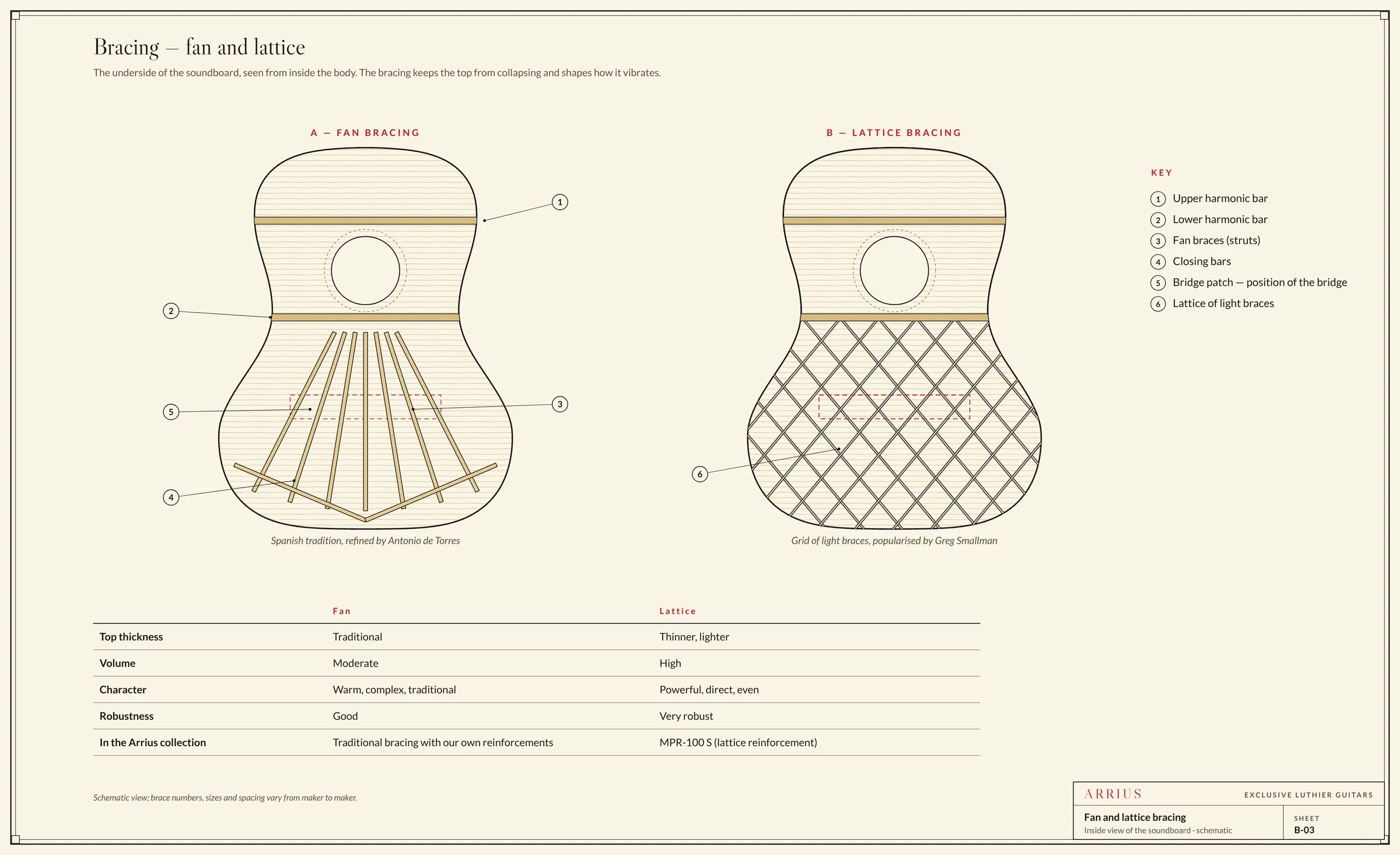
Smallman believed that the lighter the top, the more freely it would respond and the louder the guitar would be. A traditional fan-braced top cannot be made very thin without collapsing under string tension. His answer was a lattice: a grid of light struts of balsa wood reinforced with carbon fibre, glued under a top of western red cedar. The lattice carries the load, so the top itself can be extremely light.
He built his first lattice-braced guitar in 1974, and spent the following years refining it; by his own account, the early tops were still too thick. He also made the backs of his guitars heavier and more rigid than usual, so that the energy of the strings would stay concentrated in the soundboard.
Worth knowing: Smallman himself said the lattice is not the secret of his sound. The secret is the lightness of the top, and the lattice is simply the way to make such a light top survive.
John Williams and the concert stage
John Williams first approached Smallman in 1978 and bought his first Smallman guitar in 1981. He played them for decades in concerts and recordings, and their power and evenness changed what audiences and players expected from a classical guitar in a large hall. Younger players followed, and many makers around the world began to experiment with lattice bracing. Smallman shared his ideas openly and did not patent them.
What lattice bracing gives, and what it costs
- Volume and projection. Lattice guitars are typically louder and carry further.
- Evenness. Notes across the fingerboard tend to be more uniform in strength.
- Robustness. A well-made lattice top is very strong for its weight.
- Character. Some listeners find the sound more direct and less complex than a traditional fan-braced guitar; others love exactly that clarity.
Lattice in the Arrius collection
Our MPR-100 S uses lattice reinforcement of the top, which makes it louder and remarkably robust. Other models follow different paths to the same goal of a light, responsive soundboard: the S-1000 with a Nomex double top, and the Arrius MPR-5000 with traditional bracing, our own reinforcements and an additional resonance port. Fan and lattice bracing compared.
Further reading
- Greg Smallman — Wikipedia
- Greg Smallman — Guitar Foundation of America Hall of Fame
- Guitar bracing — Wikipedia
Read next
- Fan bracing and lattice bracing: the hidden architecture
- The double top, explained without myths
- Antonio de Torres and the modern classical guitar
Our key instrument: the Arrius MPR-5000, master-grade cedar and rosewood guitar with a resonance port, raised fingerboard and ebony armrest. More in the knowledge base.