For most of its history the classical guitar had no armrest. The right forearm simply lay on the edge of the lower bout, as it did on Torres’ guitars in the nineteenth century. Today a small bevel of wood on that edge has become one of the most requested details on fine instruments. It is worth asking why.
What an armrest is
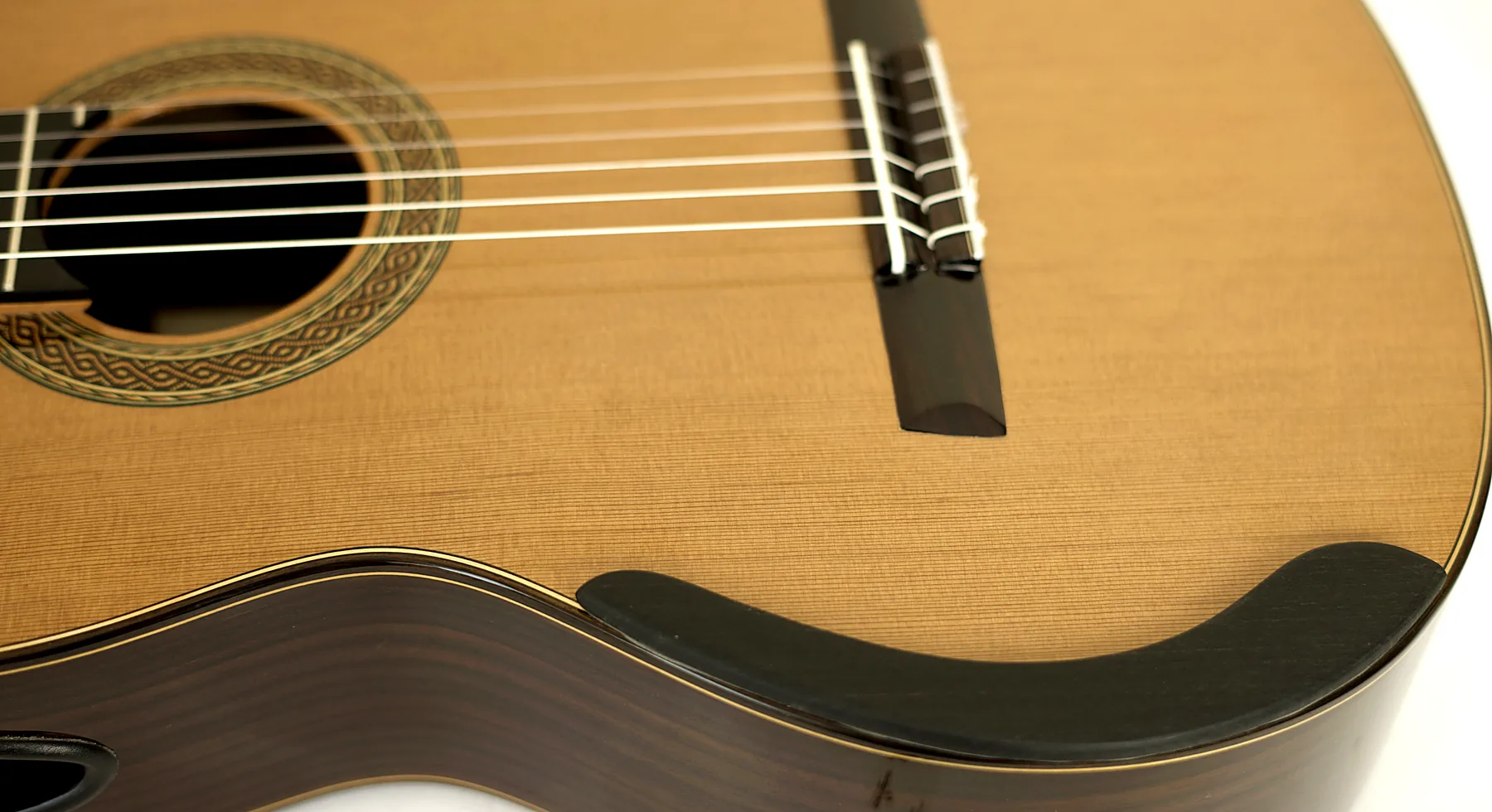
An armrest is a contoured piece of hardwood, usually ebony or rosewood, fitted along the edge of the lower bout where the right forearm rests. It replaces the sharp right angle between the top and the side with a smooth, rounded surface. Some armrests are a bevel cut into the body itself; others are an added piece that rises slightly above the top.
Three things it does
Comfort
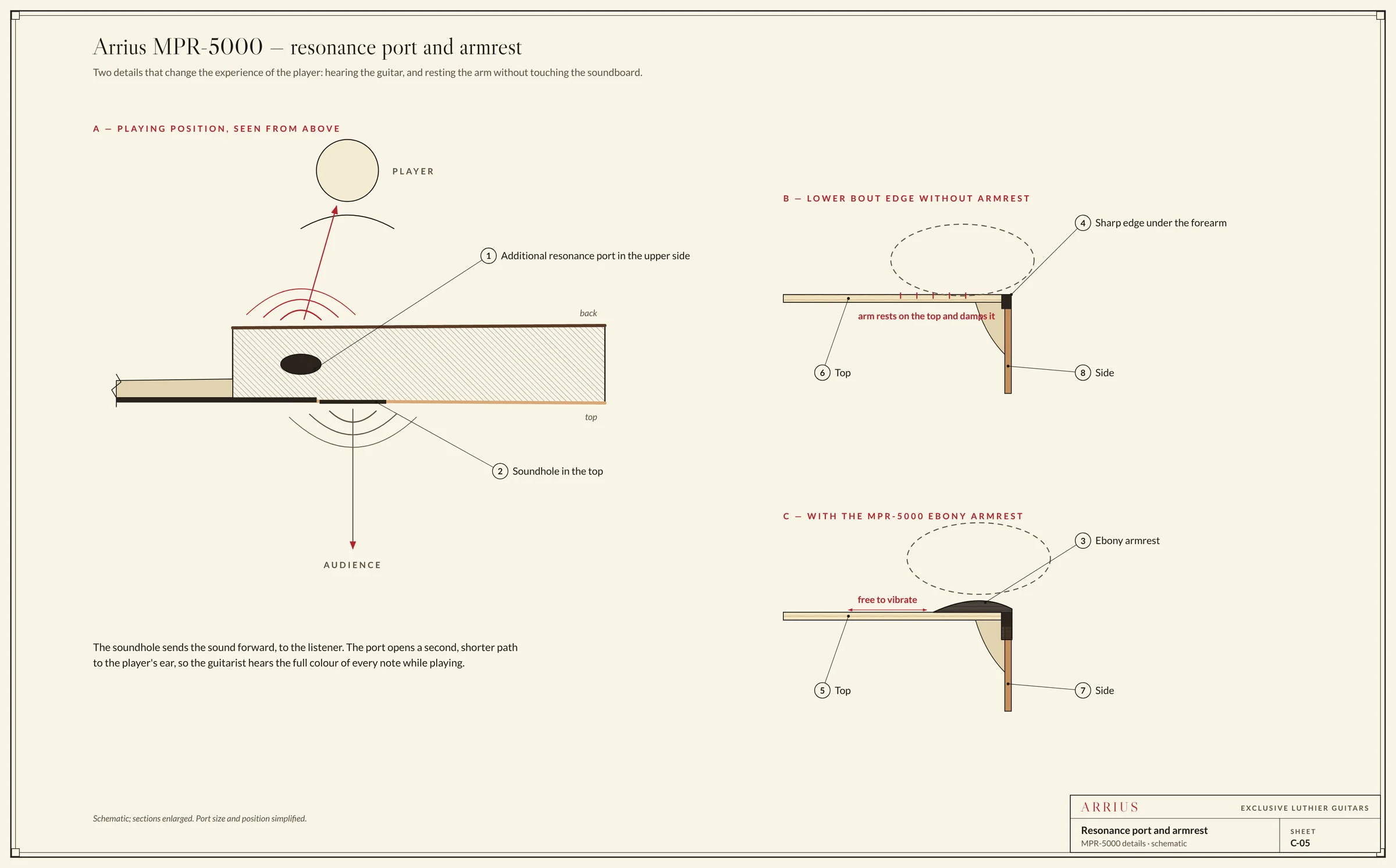
The edge of a guitar is a corner, and a corner pressed into the forearm for two hours is uncomfortable. An armrest spreads the contact over a rounded surface. Players notice it most in long practice sessions and in the last pieces of a concert programme, when every small discomfort becomes a distraction.
A freer soundboard
Without an armrest the forearm lies partly on the soundboard. The weight and soft tissue of the arm damp the vibration of the top, particularly in the area of the lower bout that carries much of the bass. Lifting the arm off the top lets that area move more freely. How much you hear depends on how heavily you rest your arm; some makers report a noticeable gain in the bass, others find the difference small in normal playing. Either way, the armrest cannot make the guitar quieter.
A listening note: play a slow bass melody with your forearm resting heavily on the top, then lift it slightly. If you hear the basses bloom, your arm has been damping your guitar, and an armrest will help.
Protection
Sweat, warmth and friction wear the finish where the arm rests, especially on soft traditional finishes such as French polish. An armrest takes that wear on a hard, durable surface instead of the top, the binding and the side.
Is there a downside?
An armrest moves the arm very slightly further from the body of the guitar, and some players need a day or two to find their usual right-hand position again. Traditionalists sometimes prefer the look of a plain edge. These are matters of taste rather than quality.
Ebony or rosewood
Ebony is the hardest and most durable choice, with a deep black colour that frames the top beautifully. Rosewood matches the back and sides and gives a warmer look. Both are excellent; what matters more is the shape, which should follow the natural line of the forearm without a ridge.
Armrests on Arrius guitars
All our classical guitars have an armrest. The Arrius MPR-5000 has a solid ebony armrest that works together with its raised fingerboard and resonance port; the S-1000 and MPR-400 also have ebony armrests, and the MPR-100 S has a specially contoured armrest designed with its cutaway.
When you clean your guitar, wipe the armrest too; it collects most of the moisture from the arm. More about caring for your instrument.
Read next
- The raised fingerboard: why lift it above the top
- The soundport: hearing what the audience hears
- French polish or lacquer?
Our key instrument: the Arrius MPR-5000, master-grade cedar and rosewood guitar with a resonance port, raised fingerboard and ebony armrest. More in the knowledge base.